 CloudConsole
Amazon Bedrock pricing explained
Bedrock on-demand inference bills per 1,000 input tokens and per 1,000 output tokens, at a price set per model; for Amazon Nova Lite in us-east-1 at the time of writing that is $0.00006 per 1,000 input tokens and $0.00024 per 1,000 output tokens. Batch inference is half the on-demand price for supported models, and provisioned throughput is billed per model unit per hour.
Example per-token prices (Amazon Nova, us-east-1)
| Model | Input per 1K tokens | Output per 1K tokens |
|---|---|---|
| Nova Micro | $0.000035 | $0.00014 |
| Nova Lite | $0.00006 | $0.00024 |
| Nova Pro | $0.0008 | $0.0032 |
| Nova Pro, batch | $0.0004 | $0.0016 |
From the AWS Price List API at the time of writing. Models from Anthropic, Meta, Mistral and other providers each have their own prices, some billed through AWS Marketplace; check the Bedrock pricing page for the model you use. Output tokens cost several times input tokens on almost every model.
Worked examples
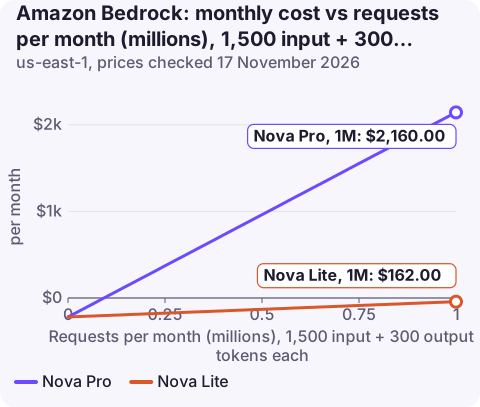
1. A support chatbot on Nova Lite. 1 million requests a month, each with 1,500 input and 300 output tokens:
- Input: 1.5 billion tokens = 1,500,000 × $0.00006 = $90.00
- Output: 300 million tokens = 300,000 × $0.00024 = $72.00
- Total: $162.00
2. The same traffic on Nova Pro. 1,500,000 × $0.0008 = $1,200.00 plus 300,000 × $0.0032 = $960.00, $2,160.00. Model choice moves the bill by an order of magnitude.
3. Batch summarisation. 10,000 documents of 20,000 tokens each with 1,000-token summaries on Nova Pro batch: 200,000 × $0.0004 = $80.00 plus 10,000 × $0.0016 = $16.00, $96.00, half the on-demand $192.00.
Other ways Bedrock bills
- Provisioned throughput: model units reserved per hour, with or without a one- or six-month commitment; needed for custom models and guaranteed capacity.
- Prompt caching: cached input tokens are billed at a reduced rate on models that support it, which helps long system prompts.
- Knowledge Bases: the vector store behind them (for example OpenSearch Serverless) bills separately, plus embedding model tokens; see OpenSearch pricing.
- Agents and Flows bill the model calls they make, often several per user request.
- Guardrails bill per text unit evaluated by each policy.
- Model customisation bills training tokens and monthly model storage.
Hidden multipliers
- Conversation history resent with every turn grows input tokens quadratically over a chat.
- Retries and agent loops repeat whole prompts.
- Invocation logging to CloudWatch Logs or S3 stores every prompt and response.
- Cross-Region inference profiles keep the source Region's price but can change where data is processed.
Seeing Bedrock cost
Bedrock usage types name the model and direction, such as USE1-NovaLite-input-tokens and USE1-NovaLite-output-tokens; third-party models may appear under AWS Marketplace. To split cost by application, create application inference profiles with cost allocation tags and call the model through them. The InputTokenCount and OutputTokenCount CloudWatch metrics per model show volume before the bill does.
Questions
How is Amazon Bedrock priced?
Per 1,000 input and output tokens for on-demand inference, at a price set per model, or per model unit-hour for provisioned throughput. Batch inference is discounted for supported models.
What does Bedrock cost per token?
It depends on the model: Amazon Nova Micro is $0.000035 per 1,000 input tokens and Nova Pro $0.0008 in us-east-1 at the time of writing; third-party models have their own prices.
Is Bedrock batch inference cheaper?
Yes, for supported models batch prices are half of on-demand, in exchange for asynchronous processing of a job file.
Token spend can climb within hours when an agent loops. CloudConsole is being built to show costs and alarms on a phone, so a spike is visible early.
About the app → · Download on the App Store