 CloudConsole
ALB and NLB pricing explained
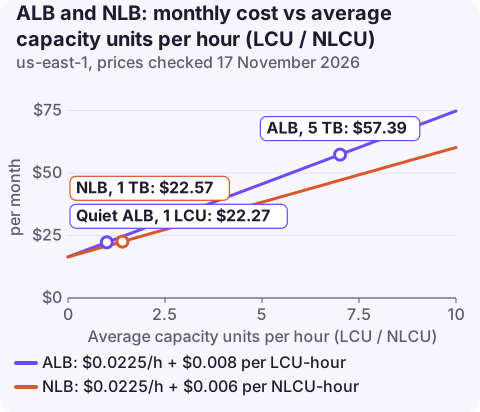
An Application Load Balancer costs $0.0225 per hour (about $16.43 a month) plus $0.008 per LCU-hour, in us-east-1 at the time of writing; a Network Load Balancer has the same hourly price and $0.006 per NLCU-hour. Each hour you are billed for whichever LCU dimension (new connections, active connections, processed bytes or rule evaluations) is highest.
Pricing dimensions
| Dimension | ALB | NLB |
|---|---|---|
| Load balancer-hour | $0.0225 | $0.0225 |
| Capacity unit-hour | $0.008 per LCU | $0.006 per NLCU |
| Reserved capacity (LCU reservation) | $0.008 per reserved LCU-hour | $0.006 per reserved NLCU-hour |
From the AWS Price List API at the time of writing. Internet-facing load balancers also pay for their public IPv4 addresses (one per Availability Zone node), billed under VPC; see public IPv4 pricing.
What one LCU covers
| Dimension | ALB: 1 LCU = | NLB (TCP): 1 NLCU = |
|---|---|---|
| New connections | 25 per second | 800 per second |
| Active connections | 3,000 per minute | 100,000 |
| Processed bytes | 1 GB per hour (0.4 GB for Lambda targets) | 1 GB per hour |
| Rule evaluations | 1,000 per second (first 10 rules free) | Not applicable |
Only the highest dimension in each hour is billed. For most web apps that is processed bytes; for APIs with many short connections it can be new connections; for long-lived WebSocket or gRPC streams, active connections.
Worked examples
1. A quiet internal ALB. Averaging 1 LCU: $16.43 for the hours plus 730 × $0.008 = $5.84, $22.27 a month. Ten such ALBs across environments cost $222.70.
2. An ALB serving 5 TB a month. Bytes dominate: 5,120 GB spread over 730 hours is about 7 LCU on average, and 5,120 × $0.008 = $40.96 in LCU charges, so $57.39 with the hourly charge.
3. An NLB carrying 1 TB. $16.43 for the hours plus 1,024 × $0.006 = $6.14, $22.57. An internet-facing load balancer in two AZs adds 2 × 730 × $0.005 = $7.30 for its public IPv4 addresses.
Easy-to-miss charges
- One ALB per service in Kubernetes or ECS, where an ingress controller sharing one ALB with host or path rules would do.
- Cross-zone traffic on NLB: with cross-zone load balancing on, NLB traffic between zones is billed as inter-AZ data transfer (ALB cross-zone traffic is not).
- Access logs written to S3, billed as S3 storage and requests.
- AWS WAF on the ALB, billed per web ACL, rule and request; see WAF pricing.
- Idle load balancers left from deleted stacks: they keep their hourly charge with no traffic.
Seeing load balancer cost
Cost Explorer lists load balancers under Elastic Load Balancing. Group by Usage type for LoadBalancerUsage (hours) and LCUUsage (capacity units); in us-east-1 these have no Region prefix. The ConsumedLCUs metric per ALB shows which load balancer burns capacity, and ProcessedBytes, NewConnectionCount and ActiveConnectionCount show which dimension drives it. For 503s from an ALB, see ALB 503 Service Unavailable.
Cutting it: load balancer cost.
Questions
How much does an ALB cost per month?
About $16.43 for the hours in us-east-1 at the time of writing, plus $0.008 per LCU-hour; one averaging 1 LCU comes to about $22 a month.
What is an LCU on an ALB?
A load balancer capacity unit: 25 new connections a second, 3,000 active connections a minute, 1 GB processed an hour or 1,000 rule evaluations a second. You pay for the highest of the four each hour.
Is NLB cheaper than ALB?
The hourly price is the same, and an NLCU is $0.006 against $0.008 for an LCU, so NLB is usually cheaper for raw TCP traffic. ALB is needed for HTTP routing, WAF and authentication.
ALB 5XX alarms are among the first signs of a bad deploy. CloudConsole is being built to show load balancer alarms on a phone.
About the app → · Download on the App Store