 CloudConsole
Amazon EFS pricing explained
EFS bills storage per GB-month used ($0.30 for Standard, $0.025 for Infrequent Access and $0.008 for Archive in us-east-1 at the time of writing) plus throughput: in Elastic mode, $0.03 per GB read and $0.06 per GB written. Unlike EBS you pay only for data stored, but per GB it is several times the price of gp3.
Pricing dimensions
| Dimension | Unit | us-east-1 price |
|---|---|---|
| Standard storage | GB-month | $0.30 |
| Infrequent Access storage | GB-month | $0.025 |
| Archive storage | GB-month | $0.008 |
| One Zone storage | GB-month | $0.16 |
| Elastic throughput reads / writes | GB transferred | $0.03 / $0.06 |
| Infrequent Access reads (and tiering into IA) | GB | $0.01 |
| Provisioned throughput | MiB/s-month | $6.00 |
From the AWS Price List API at the time of writing. Elastic throughput is the default for new file systems; Bursting mode has no separate throughput charge but limits throughput by size.
Worked examples
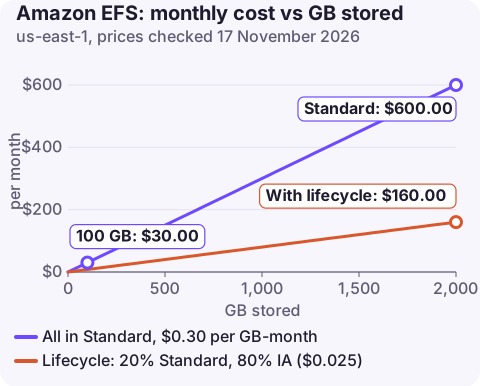
1. A small shared volume. 100 GB in Standard with Elastic throughput, 200 GB read and 50 GB written a month:
- Storage: 100 × $0.30 = $30.00
- Reads: 200 × $0.03 = $6.00
- Writes: 50 × $0.06 = $3.00
- Total: $39.00
2. Lifecycle management. 2,000 GB of which 400 GB is active: 400 × $0.30 = $120.00 in Standard plus 1,600 × $0.025 = $40.00 in IA is $160.00, against 2,000 × $0.30 = $600.00 all in Standard. Reading 100 GB from IA adds 100 × $0.01 = $1.00.
3. Provisioned throughput. Fixing throughput at 100 MiB/s costs 100 × $6.00 = $600.00 a month on top of storage. Only worth it when Elastic charges for a steady, heavy workload would cost more.
EFS against EBS and S3
Per GB, EFS Standard costs nearly four times gp3, but you share it across many instances or containers and never provision unused space. For data read rarely, IA and Archive are cheaper than S3 Standard per GB, but EFS access charges apply. Pick EFS for a POSIX file system shared by many clients; use EBS for one instance's disk and S3 for objects.
Charges people miss
- Elastic throughput on busy workloads: a build cache or CI workspace reading terabytes a month pays per GB.
- Small files in IA: files under 128 KB are billed as 128 KB in IA and Archive.
- Backups through AWS Backup, billed per GB-month by AWS Backup.
- Cross-AZ mounts: clients in another AZ than the mount target pay data transfer.
- Replication to another Region bills storage there plus transfer.
Picking a throughput mode
Elastic throughput suits spiky or unpredictable access and bills per GB moved. Provisioned throughput suits steady, high-throughput workloads where a fixed monthly rate is cheaper. Bursting suits small file systems with light, occasional traffic, since it earns credits by size.
Seeing EFS cost
Filter Cost Explorer to Elastic File System and group by Usage type: USE1-TimedStorage-ByteHrs (Standard), USE1-IATimedStorage-ByteHrs and USE1-ETDataAccess-Bytes (Elastic throughput). The CloudWatch metrics StorageBytes and MeteredIOBytes show size and traffic per file system.
Questions
How much does EFS cost per GB?
$0.30 per GB-month for Standard, $0.025 for Infrequent Access and $0.008 for Archive in us-east-1 at the time of writing, plus throughput charges.
Is EFS more expensive than EBS?
Per GB stored, yes: Standard is $0.30 against $0.08 for gp3. You only pay for what you store on EFS, though, and lifecycle tiering can bring the average far down.
Is EFS cheaper than S3?
Not for active data: EFS Standard is $0.30 per GB-month against $0.023 for S3 Standard. EFS Archive is cheaper per GB than S3 Standard but charges for access.
What does EFS Elastic throughput cost?
$0.03 per GB read and $0.06 per GB written in us-east-1 at the time of writing.
EFS throughput cost moves with workload, so a new job reading the whole file system shows up fast. CloudConsole is being built to show costs and alarms on a phone.
About the app → · Download on the App Store