 CloudConsole
Kinesis Data Streams pricing explained
In provisioned mode Kinesis Data Streams bills $0.015 per shard-hour plus $0.014 per million PUT payload units (25 KB each); in on-demand mode it bills $0.04 per stream-hour, $0.08 per GB written and $0.04 per GB read, in us-east-1 at the time of writing. Extended retention and enhanced fan-out consumers are charged on top.
Pricing dimensions
| Mode | Dimension | us-east-1 price |
|---|---|---|
| Provisioned | Shard-hour | $0.015 |
| Provisioned | PUT payload units (25 KB) | $0.014 per million |
| Provisioned | Extended retention, per shard-hour | $0.020 |
| On-demand | Stream-hour | $0.04 |
| On-demand | Data written / read | $0.08 / $0.04 per GB |
| Both | Enhanced fan-out consumer-shard-hour / data retrieved | $0.015 / $0.013 per GB |
From the AWS Price List API at the time of writing. A shard accepts up to 1 MB/s or 1,000 records/s of writes. Every record uses at least one 25 KB payload unit, so many tiny records cost more than fewer batched ones.
Worked examples
1. Provisioned, 1,000 records a second of 1 KB. Two shards for headroom, 2.628 billion records a month:
- Shards: 2 × 730 × $0.015 = $21.90
- PUT units: 2,628 million × $0.014 = $36.79
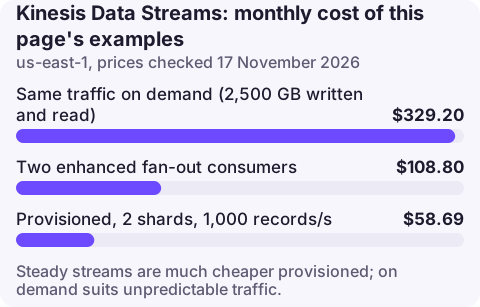
- Total: $58.69 a month
2. The same traffic on demand. Treating it as 2,500 GB written and read once: 730 × $0.04 = $29.20 plus 2,500 × $0.08 = $200.00 written plus 2,500 × $0.04 = $100.00 read, $329.20. On-demand is convenient for unpredictable streams, but steady streams are much cheaper provisioned.
3. Two enhanced fan-out consumers. On the two-shard stream: 2 × 2 × 730 × $0.015 = $43.80 plus 2 × 2,500 × $0.013 = $65.00, $108.80 a month.
Choosing a mode
On-demand scales automatically and removes resharding, at a premium per GB. Provisioned needs you to size and reshard, but costs far less for predictable volume. You can switch a stream between modes a limited number of times a day. For delivering a stream straight to S3 or a warehouse, Data Firehose may replace custom consumers; it is billed separately per GB ingested.
Charges people miss
- Small records without aggregation (KPL or batching) each consume a full PUT payload unit.
- Idle shards after a traffic drop, still billed hourly.
- Extended retention set to days for a stream that only needs 24 hours.
- Lambda consumers polling with GetRecords count as reads in on-demand mode.
- KMS encryption with a customer managed key adds KMS requests.
Sizing shards
Each shard takes 1 MB/s or 1,000 records/s of writes and serves 2 MB/s of reads shared by standard consumers. Size for peak write throughput with some headroom, and use enhanced fan-out when several consumers each need the full read rate.
Seeing Kinesis cost
In Cost Explorer under Kinesis, group by Usage type: Storage-ShardHour and PutRequestPayloadUnits for provisioned streams, OnDemand-StreamHour and OnDemand-BilledIncomingBytes for on-demand. The IncomingBytes and IncomingRecords metrics per stream show whether bytes or record count should drive sizing.
Questions
How much does a Kinesis shard cost?
$0.015 per shard-hour, about $10.95 a month, in us-east-1 at the time of writing, plus $0.014 per million PUT payload units.
Is Kinesis on-demand more expensive?
Per GB, yes: $0.08 per GB written and $0.04 per GB read plus $0.04 per stream-hour. For steady traffic, provisioned shards are usually several times cheaper.
How is Kinesis Data Firehose priced?
Separately, mainly per GB ingested, with extra charges for format conversion and some destinations.
A consumer falling behind shows up as iterator age long before it shows up as cost. CloudConsole is being built to show alarms like that on a phone.
About the app → · Download on the App Store