 CloudConsole
DynamoDB pricing explained
DynamoDB on-demand bills $0.625 per million write request units and $0.125 per million read request units in us-east-1 at the time of writing; provisioned capacity bills $0.00065 per WCU-hour and $0.00013 per RCU-hour whether you use it or not. Storage is $0.25 per GB-month after the first 25 GB, and backups, streams and global tables add their own charges.
Pricing dimensions
| Dimension | Unit | us-east-1 price |
|---|---|---|
| On-demand writes | million WRU | $0.625 |
| On-demand reads | million RRU | $0.125 |
| Provisioned write capacity | WCU-hour | $0.00065 |
| Provisioned read capacity | RCU-hour | $0.00013 |
| Storage, Standard table class | GB-month (after 25 GB free) | $0.25 |
| Storage, Standard-IA table class | GB-month | $0.10 |
| Point-in-time recovery | GB-month | $0.20 |
| On-demand backup / restore | GB-month / GB | $0.10 / $0.15 |
From the AWS Price List API at the time of writing. A write unit covers an item up to 1 KB; a read unit covers one strongly consistent read of up to 4 KB, or two eventually consistent reads. Transactional reads and writes use twice the units.
Worked examples
1. An on-demand app table. 30 million writes of items under 1 KB, 120 million eventually consistent reads under 4 KB, 40 GB stored:
- Writes: 30 × $0.625 = $18.75
- Reads: 120 million ÷ 2 = 60 million RRU × $0.125 = $7.50
- Storage: (40 − 25) × $0.25 = $3.75
- Total: $30.00 a month
2. Steady provisioned load. 100 WCU and 400 RCU all month. The free tier covers 25 of each (18,600 unit-hours):
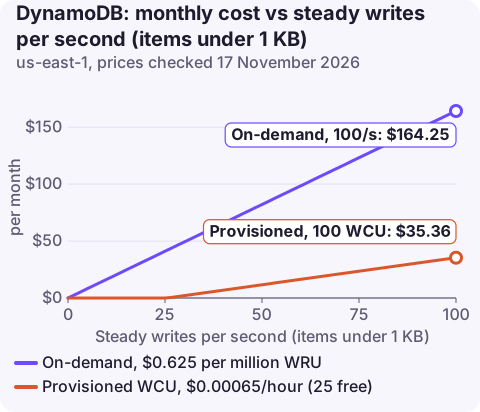
- Writes: (100 × 730 − 18,600) × $0.00065 = 54,400 × $0.00065 = $35.36
- Reads: (400 × 730 − 18,600) × $0.00013 = 273,400 × $0.00013 = $35.54
- Total: $70.90. The same 100 writes a second on demand would be 262.8 million WRU × $0.625 = $164.25 for writes alone.
3. Turning on PITR. Point-in-time recovery on a 200 GB table: 200 × $0.20 = $40.00 a month.
On-demand or provisioned?
On-demand costs more per request but nothing when idle, and absorbs spikes without throttling. Provisioned with auto scaling is cheaper once a table is busy most hours, because you pay for capacity rather than requests. A WCU used flat out for an hour performs 3,600 writes, so provisioned writes work out at $0.00065 ÷ 3,600 × 1,000,000 = $0.18 per million at full utilisation, against $0.625 on demand: provisioned wins once average utilisation of what you provision is above about 29%. You can switch a table's mode, with limits on how often.
Charges people miss
- Global secondary indexes consume their own write units for every base-table write that touches them, and their own storage.
- Item size: a 3 KB item costs three WRUs per write; large attributes multiply cost.
- Global tables bill replicated writes in each Region plus inter-Region transfer.
- Scans read every item and are billed for every 4 KB read, filtered or not.
- Streams read by Lambda are free; other consumers pay per read request.
- Exports to S3 are billed per GB exported.
Seeing DynamoDB cost
In Cost Explorer filter Service = DynamoDB and group by Usage type: WriteRequestUnits and ReadRequestUnits for on-demand, WriteCapacityUnit-Hrs and ReadCapacityUnit-Hrs for provisioned, TimedStorage-ByteHrs for storage. Per-table cost needs cost allocation tags on the tables; CloudWatch ConsumedWriteCapacityUnits shows which table is consuming.
Cutting it: on-demand vs provisioned cost.
Questions
How much does DynamoDB cost per read?
On demand, $0.125 per million read request units in us-east-1 at the time of writing; an eventually consistent read of up to 4 KB uses half a unit.
Is DynamoDB on-demand more expensive than provisioned?
Per request, yes. For tables that are busy around the clock, provisioned capacity with auto scaling is usually much cheaper; for spiky or low traffic, on-demand often wins.
Is there a DynamoDB free tier?
Yes: 25 GB of storage and 25 WCU and 25 RCU of provisioned capacity per month, which appear in the price list as free tiers.
How much does DynamoDB PITR cost?
$0.20 per GB-month of table size in us-east-1 at the time of writing.
Throttling and a cost spike often arrive together on a DynamoDB table. CloudConsole is being built to show alarms and costs on a phone, so you see both in one place.
About the app → · Download on the App Store