 CloudConsole
Transit Gateway vs VPC peering
Use VPC peering for a few VPCs that need to talk directly: there is no hourly charge, data within an AZ is free and performance is the best available. Use Transit Gateway once you have roughly ten or more VPCs, need shared VPN or Direct Connect access, or want central route tables for segmentation; you pay per attachment-hour and per GB processed for that simplicity.
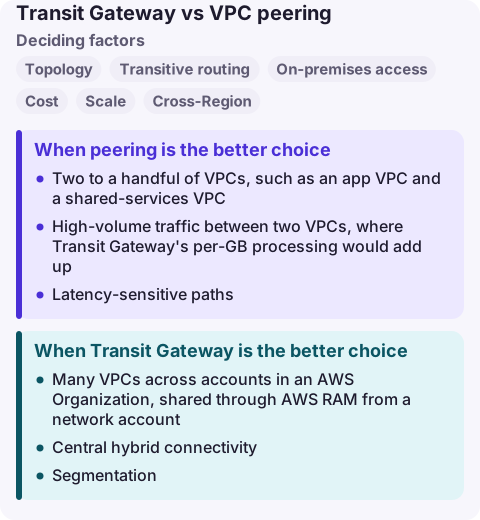
Transit Gateway vs VPC peering
| Factor | VPC peering | Transit Gateway |
|---|---|---|
| Topology | Point-to-point; a full mesh grows as n(n-1)/2 | Hub and spoke; each VPC attaches once |
| Transitive routing | Not supported | Supported, controlled by TGW route tables |
| On-premises access | Each VPC needs its own VPN or Direct Connect | Attach VPN and Direct Connect once, share with all VPCs |
| Cost | No charge to create; data transfer within an AZ free, cross-AZ and inter-Region charged | Per attachment-hour plus per GB processed, plus data transfer |
| Scale | Up to 125 active peerings per VPC | Thousands of VPCs per Regional gateway |
| Cross-Region | Inter-Region peering | TGW inter-Region peering |
| Overlapping CIDRs | Not allowed | Not routable between overlapping ranges |
When peering is the better choice
- Two to a handful of VPCs, such as an app VPC and a shared-services VPC.
- High-volume traffic between two VPCs, where Transit Gateway's per-GB processing would add up.
- Latency-sensitive paths: peering adds no extra hop.
AWS guidance is that peering suits fewer than about ten VPCs that you can manage connection by connection, and offers the lowest overall cost and highest aggregate performance of the inter-VPC options.
When Transit Gateway is the better choice
- Many VPCs across accounts in an AWS Organization, shared through AWS RAM from a network account.
- Central hybrid connectivity: one set of VPN or Direct Connect attachments for everything.
- Segmentation: separate route tables for production, non-production and shared services.
- Central inspection: routing traffic through a security VPC with AWS Network Firewall or appliances.
Using both and migrating
Mixing is normal. Keep peering for one or two heavy VPC pairs and attach everything else to Transit Gateway. When migrating a mesh to Transit Gateway, attach VPCs first, add TGW routes alongside the peering routes, then remove peering routes one VPC pair at a time. The most specific route wins, so a peering route for the exact CIDR keeps taking traffic until you delete it.
Check alternatives as well: AWS PrivateLink exposes a single service across VPCs without any routing, and VPC sharing lets several accounts use subnets in one VPC with no connection at all.
Common wrong reasons
- "Transit Gateway is always more secure." Both keep traffic private on AWS. Security comes from route tables, security groups and NACLs either way.
- "Peering is free." Creating it is; cross-AZ and inter-Region data transfer over it is charged.
- "We will need TGW eventually, so start now." With three VPCs you pay attachment and processing charges for routing you do not need yet.
Questions
Is Transit Gateway more expensive than VPC peering?
Usually yes for the same traffic, because Transit Gateway charges per attachment-hour and per GB processed while peering has no hourly charge. It saves operational effort at larger scale.
Does VPC peering support transitive routing?
No. If A peers with B and A peers with C, B cannot reach C through A. You need a direct B to C peering or a Transit Gateway.
How many VPC peering connections can a VPC have?
Up to 125 active peering connections per VPC, according to AWS networking guidance.
Routing mistakes show up as connection timeouts between services that worked yesterday, usually right after a route table change. CloudConsole is being built to show alarms alongside recent changes on a phone with production guardrails.
About the app → · Download on the App Store