 CloudConsole
Amazon API Gateway pricing explained
API Gateway bills per request: REST APIs cost $3.50 per million for the first 333 million a month and HTTP APIs $1.00 per million for the first 300 million, in us-east-1 at the time of writing. WebSocket APIs bill $1.00 per million messages plus $0.25 per million connection minutes, and an optional REST API cache bills by the hour.
Pricing dimensions
| API type | Dimension | us-east-1 price |
|---|---|---|
| REST | Requests, first 333 million / next 667 million | $3.50 / $2.80 per million |
| HTTP | Requests, first 300 million / beyond | $1.00 / $0.90 per million |
| WebSocket | Messages, first 1 billion | $1.00 per million |
| WebSocket | Connection minutes | $0.25 per million |
| REST cache | 0.5 GB cache, per hour | $0.02 |
From the AWS Price List API at the time of writing. HTTP API requests are metered in 512 KB increments and WebSocket messages in 32 KB increments, so large payloads count as several requests. Data transfer out is billed at EC2 rates.
Worked examples
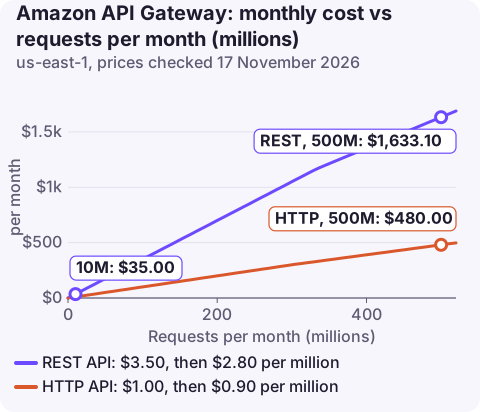
1. 10 million requests a month. REST: 10 × $3.50 = $35.00. HTTP: 10 × $1.00 = $10.00.
2. 500 million requests a month.
- REST: 333 × $3.50 = $1,165.50 plus 167 × $2.80 = $467.60, $1,633.10
- HTTP: 300 × $1.00 = $300.00 plus 200 × $0.90 = $180.00, $480.00
3. A WebSocket app. 1,000 clients connected all month (1,000 × 43,800 minutes = 43.8 million connection minutes) exchanging 50 million messages: 43.8 × $0.25 = $10.95 plus 50 × $1.00 = $50.00, $60.95.
A 0.5 GB REST cache left on all month adds 730 × $0.02 = $14.60.
REST or HTTP API?
HTTP APIs cost less than a third as much per request and have lower latency, but lack some REST features: usage plans and API keys, request validation, caching, AWS WAF integration and private endpoints. If you need those, REST is the price of having them; if you only proxy to Lambda or an HTTP backend with JWT auth, HTTP APIs are the cheaper default.
What is not in the API Gateway line
- The backend: Lambda invocations behind the API are billed by Lambda; see Lambda pricing.
- Authorizers: a Lambda authorizer runs as a Lambda invocation (cache results to reduce calls).
- Access logs and execution logs in CloudWatch Logs, billed per GB ingested.
- AWS WAF on a REST API, billed per web ACL, rule and request; see WAF pricing.
- Throttled requests (429) and requests failing authorisation with API keys or IAM are not billed; requests your integration answers with errors are.
Estimate the Lambda side with the Lambda cost calculator.
Seeing API Gateway cost
Filter Cost Explorer to API Gateway and group by Usage type: USE1-ApiGatewayRequest is REST, USE1-ApiGatewayHttpRequest HTTP APIs and USE1-ApiGatewayMessage WebSocket messages. The Count metric per API and stage shows which API drives the bill. For timeouts at the edge of the API, see API Gateway 504 errors.
Questions
How much does API Gateway cost per request?
REST APIs are $3.50 per million requests ($0.0000035 each) and HTTP APIs $1.00 per million, for the first tier in us-east-1 at the time of writing.
Is HTTP API cheaper than REST API?
Yes, $1.00 against $3.50 per million requests at the first tier, but HTTP APIs lack features such as caching, usage plans and WAF integration.
Does API Gateway charge for failed requests?
Requests rejected by throttling or by API key and IAM authorisation are not billed. Requests that reach your integration are billed even if it returns an error.
Is there an API Gateway free tier?
New accounts get a limited free-tier offer for the first months; check the AWS Free Tier page for your account.
A retry storm against your API shows up as 5XX alarms first and as cost later. CloudConsole is being built to show both on a phone.
About the app → · Download on the App Store