 CloudConsole
Amazon GuardDuty pricing explained
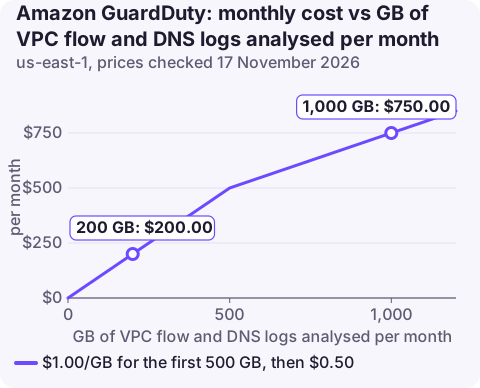
GuardDuty bills by the volume it analyses: $4.00 per million CloudTrail management events and $1.00 per GB of VPC Flow Logs and DNS logs for the first 500 GB a month (cheaper beyond), in us-east-1 at the time of writing. Optional protection plans for S3, EKS, Runtime Monitoring, Malware Protection and others add their own charges. Each account gets a 30-day free trial.
Pricing dimensions
| Dimension | Unit | us-east-1 price |
|---|---|---|
| CloudTrail management events | million events | $4.00 |
| VPC Flow Logs and DNS query logs, first 500 GB / next 2,000 GB | GB | $1.00 / $0.50 |
| S3 Protection: S3 data events, first 500 million | million events | $0.80 |
| EKS Protection: audit logs, first 100 million | million events | $1.60 |
| Runtime Monitoring for Fargate, first 500 vCPUs | vCPU-month | $1.50 |
From the AWS Price List API at the time of writing. GuardDuty reads these sources from AWS directly; you do not need to enable VPC Flow Logs or CloudTrail data events yourself, and you are not billed by those services for GuardDuty's analysis.
Worked examples
1. A mid-sized account. 5 million CloudTrail events and 200 GB of flow and DNS logs: 5 × $4.00 = $20.00 plus 200 × $1.00 = $200.00, $220.00 a month. Network logs usually dominate.
2. S3 Protection on busy buckets. 300 million S3 data events: 300 × $0.80 = $240.00.
3. Heavy network traffic. 1,000 GB of flow and DNS logs: 500 × $1.00 + 500 × $0.50 = $750.00.
Kubernetes and runtime protection
EKS Protection analyses Kubernetes audit logs: a busy cluster producing 50 million audit events a month costs 50 × $1.60 = $80.00. Runtime Monitoring is billed per vCPU monitored, so 100 vCPUs of Fargate tasks running all month add 100 × $1.50 = $150.00. Both scale with cluster size rather than with security events, so estimate them from your average vCPU count and audit log volume before turning them on for every account.
Estimating before you enable it
The 30-day trial is the best estimator: GuardDuty's console shows projected monthly cost per account and per data source during the trial. Run the trial in a representative account before enabling GuardDuty across an organisation, and check which protection plans auto-enable will switch on for new accounts.
Charges people miss
- Protection plans enabled by default for new member accounts through organisation auto-enable.
- NAT-heavy or chatty VPCs producing large flow log volumes.
- Runtime Monitoring billed per vCPU of EC2, EKS or Fargate monitored.
- Malware Protection for S3, billed per GB scanned and per object evaluated.
- Every enabled Region is billed separately; disabling GuardDuty in unused Regions is a security trade-off, so prefer SCPs that block those Regions instead.
Seeing GuardDuty cost
Group Cost Explorer by Usage type under GuardDuty: USE1-PaidEventsAnalyzed (CloudTrail), USE1-PaidEventsAnalyzed-Bytes (flow and DNS logs), USE1-PaidS3DataEventsAnalyzed (S3 Protection). The GuardDuty console's Usage page breaks cost down by account and data source.
Cutting it: reducing GuardDuty cost.
Questions
How much does GuardDuty cost?
It depends on volume: $4.00 per million CloudTrail events and $1.00 per GB of flow and DNS logs for the first 500 GB in us-east-1 at the time of writing, plus any protection plans.
Is there a GuardDuty free trial?
Yes, 30 days per account and Region, with an estimate of the monthly cost shown in the console.
How much does GuardDuty S3 Protection cost?
$0.80 per million S3 data events for the first 500 million a month, at the time of writing.
A high-severity GuardDuty finding deserves a look within minutes. CloudConsole is being built to bring alarms to a phone with production guardrails.
About the app → · Download on the App Store