 CloudConsole
ap-southeast-5: Asia Pacific (Malaysia)
ap-southeast-5 is the code for the Asia Pacific (Malaysia) region. It is an opt-in region that must be enabled per account, and it is aimed at Malaysian organisations, particularly financial institutions, public bodies and companies with Malaysian customers, that want data hosted in Malaysia.
Reasons to choose Malaysia
- Financial regulation. Malaysian banks and insurers follow Bank Negara Malaysia's technology risk requirements, which cover cloud adoption and outsourcing. Local hosting simplifies the risk assessment, though it doesn't replace it.
- Public sector. Government agencies and their suppliers often prefer in-country hosting.
- Personal data. Malaysia's Personal Data Protection Act governs personal data, including transfers abroad; check the current rules for your case.
- Latency. Singapore is already close to much of Peninsular Malaysia, so latency alone is rarely the deciding factor. For Sabah and Sarawak users, measure both.
Enabling ap-southeast-5
aws account get-region-opt-status --region-name ap-southeast-5
aws account enable-region --region-name ap-southeast-5

# confirm it is now listed as opted in
aws ec2 describe-regions --all-regions \
  --query "Regions[?RegionName=='ap-southeast-5'].[RegionName,OptInStatus]" \
  --output text
Use an up-to-date CLI and SDK; older releases may not include the region in their endpoint data. In AWS Organizations, enable it per member from the management account and adjust any region allow-list SCPs.
Targeting the Malaysia region
Use --region ap-southeast-5, AWS_REGION=ap-southeast-5 or a profile setting; endpoints follow <service>.ap-southeast-5.amazonaws.com. The region's display name is just "Asia Pacific (Malaysia)" rather than a city, so search for the code, not a city name, in AWS's lists.
If calls fail with a token error here but work in Singapore, the session token probably came from the global STS endpoint, which by default isn't valid in opt-in regions.
A split design with Singapore
Many Malaysian companies already run in ap-southeast-1. A pragmatic path is to move regulated data and the services that process it to ap-southeast-5, and leave shared tooling and non-regulated workloads in Singapore. Keep the data flow one-way where possible: send aggregated or anonymised results out of Malaysia, not raw records. As with any new region, the catalogue is smaller, so check each service on the AWS Regional Services List and raise quotas before migrating.
Neighbours
| Region | Notes |
|---|---|
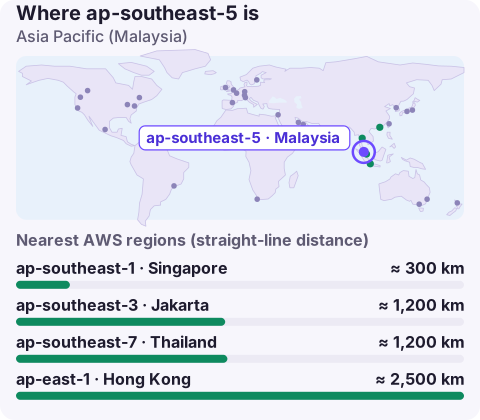
| ap-southeast-1 (Singapore) | Closest large region; enabled by default |
| ap-southeast-3 (Jakarta) | Indonesia; opt-in |
| ap-southeast-7 (Thailand) | Opt-in |
If your rules allow recovery outside Malaysia, Singapore is the natural partner.
Evidence your auditors will ask for
Moving to an in-country region is half the work; proving it is the other half. Be ready to show: an inventory of resources by region (AWS Config or the Resource Groups Tagging API), KMS keys created in ap-southeast-5 and their key policies, CloudTrail logs proving administrative access, SCPs that prevent copies to other regions, and AWS's own compliance reports from AWS Artifact. Gathering these once and refreshing them each quarter is far easier than reconstructing them when the regulator asks.
Questions
Where is ap-southeast-5?
In Malaysia. AWS names it Asia Pacific (Malaysia).
Is ap-southeast-5 enabled by default?
No. It's an opt-in region; enable it before use.
Should I move from Singapore to the Malaysia region?
If you need Malaysian hosting for regulatory or contractual reasons, yes, at least for regulated data. Otherwise Singapore's broader catalogue may be simpler.
A split between two regions means two sets of alarms to watch. CloudConsole, a phone app for AWS, is built to show alarms and resources across regions on your phone.
About the app → · Download on the App Store