 CloudConsole
Aurora Serverless v2 pricing explained
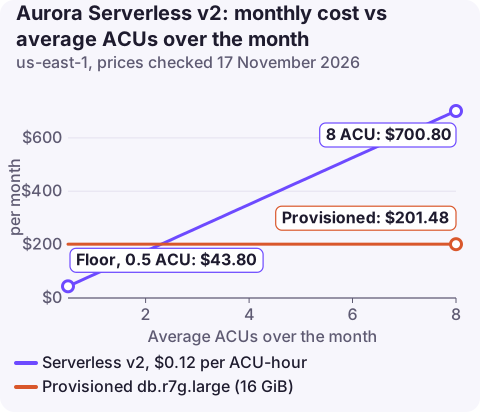
Aurora Serverless v2 bills capacity in Aurora Capacity Units (ACUs), measured per second: $0.12 per ACU-hour on Aurora Standard and $0.16 on I/O-Optimized, in us-east-1 at the time of writing for Aurora PostgreSQL. Storage and I/O are billed exactly as for provisioned Aurora, so a database idling at 0.5 ACU costs about $43.80 a month before storage.
What you pay for
| Dimension | Standard | I/O-Optimized |
|---|---|---|
| Capacity, per ACU-hour | $0.12 | $0.16 |
| Storage, per GB-month | $0.10 | $0.225 |
| I/O, per million requests | $0.20 | Included |
us-east-1, Aurora PostgreSQL, from the AWS Price List API at the time of writing; Aurora MySQL Serverless v2 uses the same ACU price. One ACU is about 2 GiB of memory with matching CPU and networking. Capacity moves in half-ACU steps between the minimum and maximum you set, and every Serverless v2 instance in the cluster, readers included, bills its own ACUs.
Worked examples
1. The floor. A dev database at its 0.5 ACU minimum all month: 0.5 × 730 × $0.12 = $43.80.
2. A business-hours app. 4 ACU for 220 working hours and 1 ACU for the other 510 hours, 100 GB of data and 300 million I/Os:
- Capacity: (4 × 220 + 1 × 510) = 1,390 ACU-hours × $0.12 = $166.80
- Storage: 100 × $0.10 = $10.00
- I/O: 300 × $0.20 = $60.00
- Total: $236.80 a month
3. Steady load. 8 ACU (about 16 GiB) around the clock: 8 × 730 × $0.12 = $700.80. A provisioned db.r7g.large with 16 GiB of memory is 730 × $0.276 = $201.48. For flat, predictable load, provisioned is far cheaper; Serverless v2 earns its premium when load swings or the database sits idle.
Minimum capacity and pausing
The minimum ACU setting is the main cost lever. On engine versions that support it, a minimum of 0 ACU lets an idle instance pause automatically and bill no capacity while paused (storage still bills); the first connection resumes it, with a delay of some seconds. On older versions the floor is 0.5 ACU, so a Serverless v2 database is never free.
Set the maximum deliberately too: a runaway query can scale a writer to its maximum and keep it there for hours.
Easy-to-miss costs
- Readers that follow the writer: readers in promotion tiers 0 and 1 scale with the writer so they can take over, so they bill the writer's capacity even when idle.
- Connections keeping it awake: pollers, health checks and connection pools stop auto-pause from ever happening.
- Buffer cache warm-up: memory-heavy workloads hold capacity higher than CPU alone suggests.
- I/O on Standard, which is billed per request just like provisioned Aurora; see Aurora pricing.
Watching ACU spend
The CloudWatch metric ServerlessDatabaseCapacity shows ACUs per instance over time, and ACUUtilization shows how close it is to the maximum. In Cost Explorer, Serverless v2 capacity appears under Relational Database Service with the usage type Aurora:ServerlessV2Usage (or Aurora:ServerlessV2IOOptimizedUsage). Multiply the average capacity metric by 730 and the ACU price to sanity-check the monthly figure.
Questions
What is the minimum cost of Aurora Serverless v2?
At a 0.5 ACU minimum, about $43.80 a month in us-east-1 at the time of writing, plus storage. On versions that support a 0 ACU minimum, an idle paused instance bills no capacity.
How much is an ACU per hour?
$0.12 per ACU-hour on Aurora Standard and $0.16 on I/O-Optimized in us-east-1, at the time of writing.
Is Aurora Serverless v2 cheaper than RDS?
For steady load, no: 8 ACU all month is $700.80 against $201.48 for a provisioned db.r7g.large with similar memory. It is cheaper for databases that are idle most of the time.
Do Aurora Serverless v2 readers cost extra?
Yes. Each reader bills its own ACUs, and readers in promotion tiers 0 and 1 scale up with the writer.
A Serverless v2 writer stuck at its maximum is easy to miss until the bill arrives. CloudConsole is being built to show alarms and costs on a phone, so a capacity alarm reaches you wherever you are.
About the app → · Download on the App Store