 CloudConsole
Amazon RDS pricing explained
RDS charges per hour for the DB instance (by class, engine and Single-AZ or Multi-AZ), per GB-month for provisioned storage, and for backup storage beyond the free allowance. In us-east-1 at the time of writing a db.m7g.large running PostgreSQL is $0.168 per hour Single-AZ and $0.337 Multi-AZ, and gp3 storage is $0.115 per GB-month ($0.23 for Multi-AZ).
Pricing dimensions (PostgreSQL)
| Dimension | Single-AZ | Multi-AZ |
|---|---|---|
| db.t4g.medium, per hour | $0.065 | $0.129 |
| db.m7g.large, per hour | $0.168 | $0.337 |
| db.r7g.large, per hour | $0.239 | $0.478 |
| gp3 storage, per GB-month | $0.115 | $0.23 |
| Backup storage beyond the free allowance, per GB-month | $0.095 | |
us-east-1 on-demand, from the AWS Price List API at the time of writing. MySQL and MariaDB use the same instance prices for these classes; SQL Server and Oracle include licence costs and are much higher.
Multi-AZ (one standby) doubles both the instance and the storage price, because AWS runs and stores a second copy in another Availability Zone.
Worked examples
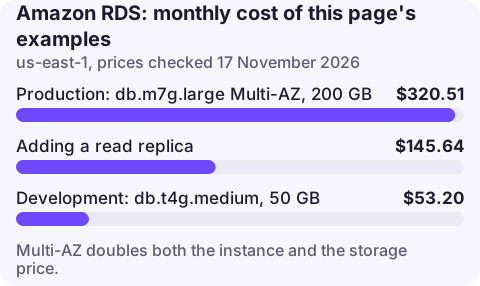
1. Development database. db.t4g.medium Single-AZ with 50 GB gp3:
- Instance: 730 × $0.065 = $47.45
- Storage: 50 × $0.115 = $5.75
- Total: $53.20 a month.
2. Production database. db.m7g.large Multi-AZ, 200 GB gp3, and 500 GB of snapshots and retained backups (200 GB of it free):
- Instance: 730 × $0.337 = $246.01
- Storage: 200 × $0.23 = $46.00
- Extra backup: 300 × $0.095 = $28.50
- Total: $320.51 a month.
3. The read replica. Adding one db.m7g.large replica Single-AZ with its own 200 GB gp3 adds 730 × $0.168 + 200 × $0.115 = $122.64 + $23.00 = $145.64 a month.
What is included
- Backup storage up to 100% of the provisioned storage of your databases in a Region is free.
- Data transfer between the primary and its Multi-AZ standby is not charged.
- gp3 includes a baseline of IOPS and throughput; extra provisioned IOPS or throughput above the baseline costs more, as does io1/io2 storage.
Easy-to-miss RDS charges
- Extended Support: running a major engine version past its standard support date adds a per-vCPU-hour fee, which can exceed the instance price. Upgrade before the date.
- Manual snapshots are kept until you delete them and count toward backup storage.
- Stopped instances restart automatically after seven days, and storage bills while stopped; see stopping RDS to save money.
- Cross-AZ traffic from application servers in other Availability Zones.
- Performance Insights beyond the free retention period, and RDS Proxy, which bills per vCPU of the database it fronts.
Seeing RDS cost
Filter Cost Explorer to "Relational Database Service" and group by Usage type. Instance hours show as InstanceUsage:db.m7g.large or Multi-AZUsage:db.m7g.large, storage as RDS:GP3-Storage, and backup as RDS:ChargedBackupUsage. Group by Resource (with resource-level data enabled) to tie cost to a specific instance.
Cutting it: RDS backup storage cost and RDS Extended Support cost.
Questions
How much does RDS cost per month?
A db.t4g.medium PostgreSQL instance with 50 GB of gp3 is about $53.20 a month Single-AZ in us-east-1 at the time of writing; production Multi-AZ setups usually run to hundreds of dollars.
Does Multi-AZ double the RDS price?
For a standard Multi-AZ instance deployment, yes: both the instance-hour and storage prices roughly double. Multi-AZ DB clusters with two readable standbys are priced differently.
Is Aurora more expensive than RDS?
Aurora instances cost more per hour, but storage is billed on what you use and replicas share it. Compare on your workload; see the Aurora pricing guide.
Is RDS storage charged on used or provisioned GB?
Provisioned. You pay for the allocated size even if the database uses less, and allocated storage cannot be reduced in place.
A forgotten Multi-AZ test database is a common line on the bill. CloudConsole is being built to show RDS resources, alarms and costs on your phone.
About the app → · Download on the App Store