 CloudConsole
NatGateway-Bytes and NatGateway-Hours
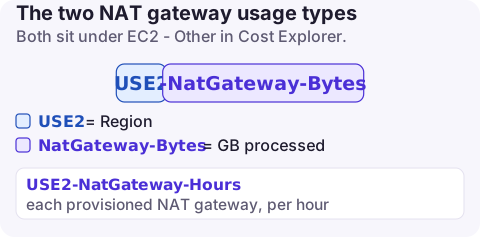
NatGateway-Bytes is the usage type for data processed by a NAT gateway, measured in GB, and NatGateway-Hours is the hourly charge for each provisioned NAT gateway. Both appear with a Region prefix, such as USE2-NatGateway-Bytes, under the EC2 - Other service in Cost Explorer.
Reading the line items
| You see | It means | Unit |
|---|---|---|
APS1-NatGateway-Bytes | Data processed by NAT gateways in ap-southeast-1 | GB |
APS1-NatGateway-Hours | Hours that NAT gateways existed in ap-southeast-1 | Hours |
NatGateway-Bytes (no prefix) | The same meter in us-east-1, which is often shown without a prefix | GB |
The prefix is a billing code, not the Region name. A few that trip people up: EU is eu-west-1, APS3 is ap-south-1 (Mumbai), and USE2 is us-east-2. The usage type decoder has the pattern for the rest.
Bytes are counted in both directions. A private instance downloading 100 GB through the gateway and uploading 5 GB generates roughly 105 GB of NatGateway-Bytes, whether the other end is the internet or an AWS service.
Sanity-check the numbers
Two quick comparisons tell you where the bytes are going:
- Hours vs expectation. Divide
NatGateway-Hoursfor the month by the hours elapsed. A result of 6 means six gateways, which may be two VPCs with three AZs each, or a forgotten test VPC. - Bytes vs internet egress. Compare
NatGateway-ByteswithDataTransfer-Out-BytesandDataTransfer-In-Bytesin the same Region. If they track each other, the traffic is genuinely leaving AWS. If NAT bytes are far higher, most of it is going to AWS services (S3, ECR, DynamoDB, other APIs) that an endpoint could carry.
# List the NAT usage types that actually appear in your bill this month
aws ce get-dimension-values --region us-east-1 \
  --time-period Start=2026-11-01,End=2026-11-17 \
  --dimension USAGE_TYPE --search-string NatGateway

# Daily cost and GB for one of them
aws ce get-cost-and-usage --region us-east-1 \
  --time-period Start=2026-11-01,End=2026-11-17 \
  --granularity DAILY --metrics UnblendedCost UsageQuantity \
  --filter '{"Dimensions":{"Key":"USAGE_TYPE","Values":["EUW2-NatGateway-Bytes"]}}'
Tie the bytes to a gateway and a workload
Cost Explorer stops at the usage type unless you have resource-level data. To go further:
- Compare each gateway's
BytesOutToDestinationandBytesInFromDestinationmetrics inAWS/NATGatewaywith the daily cost curve. - For the busy gateway, query its flow logs and sum
bytesby internal source address. Map the top addresses to instances, tasks or pods. - If you export cost and usage data (CUR) with resource IDs, filter
line_item_usage_typeon%NatGateway-Bytesand group byline_item_resource_idto see cost per gateway.
Bringing each line down
- NatGateway-Hours: delete gateways nothing routes to. Keep one per AZ that has private workloads; that is a resilience choice, not waste.
- NatGateway-Bytes: move S3 and DynamoDB traffic to gateway endpoints, which carry no processing charge, and high-volume AWS API traffic to interface endpoints. The full playbook is on NAT Gateway cost.
A mistake to avoid: fixing NatGateway-Bytes by moving workloads to public subnets with public IPs. That swaps processing for per-address IPv4 charges and widens your attack surface.
Questions
What is NatGateway-Bytes in AWS billing?
It is the per-GB data processing charge for traffic passing through a NAT gateway, in either direction and to any destination.
Why do I have NatGateway-Hours but no NatGateway-Bytes?
The gateway exists but processed little or no data. You still pay for every hour it is provisioned until you delete it.
Is NatGateway-Bytes the same as data transfer out?
No. It is a separate processing charge. Internet egress through the gateway is billed again as DataTransfer-Out-Bytes.
Usage type names like USE2-NatGateway-Bytes are hard to read on a small screen. CloudConsole, a phone app for AWS, shows spend by usage type with a plain explanation of each one, so you know what a spike is before you reach a laptop.
About the app → · Download on the App Store