 CloudConsole
AWS Transit Gateway cost
Transit Gateway charges for every attachment-hour (VPC, VPN, Direct Connect gateway, peering, Connect) and for every GB sent into it from a VPC, VPN or Direct Connect attachment. The pricing example for US East (Ohio) uses $0.05 per VPC attachment-hour and $0.02 per GB processed at the time of writing. Data processing is billed to the owner of the VPC that sends the traffic, so central teams and application teams often both see the line.
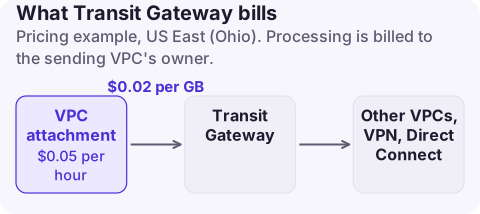
How the charge is calculated
- Attachment-hours: each attachment bills from creation (or acceptance, for shared gateways) until deleted; a partial hour is a full hour. For VPC attachments the hourly fee goes to the VPC owner's account.
- Data processing: per GB sent from an attachment to the Transit Gateway, charged to the sender. Traffic that crosses two gateways over peering is processed again, plus inter-Region transfer.
- Underlying transfer: cross-AZ or inter-Region data transfer still applies on top.
In the cost and usage data the processing line ends in TransitGateway-Bytes, with a Region prefix, alongside an attachment-hours line.
How it compounds: an application VPC sends 10 TB a month through a central inspection VPC on its way to a shared-services VPC. The application VPC pays processing on 10 TB into the gateway, the inspection VPC pays again when it sends the inspected traffic back in, and cross-AZ hops add regional transfer on top.
Find the traffic
# Attachments and their resource types
aws ec2 describe-transit-gateway-attachments \
  --query 'TransitGatewayAttachments[].[TransitGatewayAttachmentId,ResourceType,ResourceId,ResourceOwnerId,State]' \
  --output table

# Bytes into the gateway from one attachment, per day
aws cloudwatch get-metric-statistics --namespace AWS/TransitGateway \
  --metric-name BytesIn \
  --dimensions Name=TransitGateway,Value=tgw-0123456789abcdef0 Name=TransitGatewayAttachment,Value=tgw-attach-0123456789abcdef0 \
  --start-time 2026-11-10T00:00:00Z --end-time 2026-11-17T00:00:00Z \
  --period 86400 --statistics Sum
Transit Gateway flow logs (--resource-type TransitGateway on create-flow-logs) show source and destination per flow if you need to go below attachment level.
Reduce it
- Delete unused attachments, especially in old test VPCs; each one bills every hour.
- Use VPC peering for heavy pairs. Peering has no hourly or processing charge, only normal data transfer, so two VPCs exchanging terabytes are often cheaper peered directly, at the cost of more routes to manage.
- Do not hairpin S3 or DynamoDB traffic through a central egress VPC; give each VPC its own free gateway endpoints.
- Weigh centralised interface endpoints: one set of endpoints shared over Transit Gateway saves endpoint-hours but adds processing on every GB.
- Keep inspection where it is needed: routing all east-west traffic through an inspection VPC processes it twice.
What not to do
- Do not replace Transit Gateway with a mesh of peering connections across dozens of VPCs to save money; peering is not transitive and the operational cost grows fast.
- Do not forget the sending side when you estimate: chargeback by attachment owner often surprises application teams.
- Do not delete an attachment before checking route tables in every attached VPC.
Questions
How much does AWS Transit Gateway cost?
An hourly charge per attachment plus a per-GB data processing charge; the US East (Ohio) example uses $0.05 per attachment-hour and $0.02 per GB.
Who pays Transit Gateway data processing?
The owner of the VPC (or the VPN or Direct Connect attachment) that sends traffic to the Transit Gateway.
Is VPC peering cheaper than Transit Gateway?
For data, usually: peering has no processing or hourly charge. Transit Gateway is simpler to operate across many VPCs.
Transit Gateway charges land in many accounts at once, so nobody sees the total. CloudConsole, a phone app for AWS, shows spend by service and usage type per account, so the TransitGateway-Bytes line is visible wherever it lands.
About the app → · Download on the App Store