 CloudConsole
AWS cross-Region data transfer cost
Data sent from one AWS Region to another is charged per GB by the source Region, and appears as SOURCE-DESTINATION-AWS-Out-Bytes, for example USE2-APS3-AWS-Out-Bytes. The matching DESTINATION-SOURCE-AWS-In-Bytes line on the receiving side has no charge. The rate depends on the source Region, so check the pricing page for your pair.
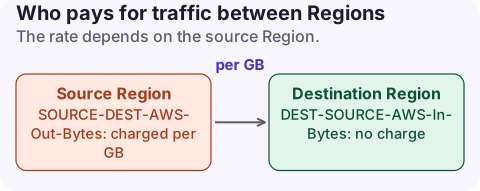
Reading the usage types
| Usage type | Meaning | Charged? |
|---|---|---|
USE2-APS3-AWS-Out-Bytes | Data from us-east-2 to ap-south-1 | Yes |
APS3-USE2-AWS-In-Bytes | The same data, arriving in ap-south-1 | No |
USE2-AWS-Out-Bytes | Inter-Region traffic over VPC peering | Yes |
EUC1-USE1-AWS-Out-ABytes | S3 Transfer Acceleration between Regions | Yes |
USE1-USW2-S3RTC-Out-Bytes | S3 Replication Time Control transfer | Yes |
The first code is always where the data left. If you see a Region you do not operate in as the source, something is running there.
What usually drives it
- S3 Cross-Region Replication of whole buckets, including logs and temporary data nobody needs in two places.
- Cross-Region backups and snapshot copies: RDS cross-Region automated backups and snapshot copies are charged for the data transferred, and storage in the destination is billed again.
- DynamoDB global tables and other multi-Region databases replicating every write.
- Compute in one Region reading data in another, often after a migration where the bucket or database stayed behind.
- Transit Gateway peering, which adds data processing on top of transfer.
Find it
# Which inter-Region pairs are you paying for?
aws ce get-dimension-values --region us-east-1 \
  --time-period Start=2026-11-01,End=2026-11-17 \
  --dimension USAGE_TYPE --search-string AWS-Out-Bytes

# Cost of those lines, by service
aws ce get-cost-and-usage --region us-east-1 \
  --time-period Start=2026-11-01,End=2026-11-17 \
  --granularity MONTHLY --metrics UnblendedCost UsageQuantity \
  --filter '{"Dimensions":{"Key":"USAGE_TYPE_GROUP","Values":["EC2: Data Transfer - Region to Region (Out)"]}}' \
  --group-by Type=DIMENSION,Key=USAGE_TYPE
If the usage type group name differs in your account, open the Usage type group filter in the console and pick the Region to Region entry; S3 and other services have their own transfer lines, so also group by Service.
Check destinations as well as sources. Data arriving in a Region you do not use points to replication or backup copies set up by a tool or a former team; organisation backup policies and S3 replication rules list their destination Regions in their configuration, which is the quickest way to find the owner.
Reduce it without losing resilience
- Keep compute next to its data. Moving a job to the bucket's Region often removes the charge entirely.
- Narrow replication. S3 replication rules can filter by prefix or tag; replicate what your recovery plan needs, not scratch space.
- Review backup copy frequency. A daily cross-Region copy of a large database may be more than the recovery point objective requires.
- Compress or aggregate before shipping logs and metrics to a central Region.
- Serve global users from CloudFront rather than replicating content to every Region yourself.
What not to do: switch off cross-Region replication or backup copies that exist for disaster recovery without agreeing it with whoever owns the recovery plan.
Questions
Is data transfer between AWS Regions free?
No. The source Region charges per GB for data sent to another Region; only the inbound line in the destination is free.
Why do I see two line items for one transfer?
The CUR records both the outbound line in the source Region and the inbound line in the destination. Only the outbound line carries a charge.
Does S3 replication cost data transfer?
Yes. Replicating objects to a bucket in another Region is billed as inter-Region transfer from the source Region, plus storage and requests in the destination.
Inter-Region transfer often appears after a migration leaves data behind. CloudConsole, a phone app for AWS, shows spend by service and usage type and spells out which Region pair a line like USE2-APS3-AWS-Out-Bytes refers to.
About the app → · Download on the App Store