 CloudConsole
S3 bucket policy: require SSE-KMS encryption on uploads
S3 already encrypts every new object (SSE-S3 by default), so the old "deny unencrypted uploads" policy is mostly obsolete. To require KMS, set the bucket's default encryption to SSE-KMS with your key, then add Deny statements that reject a PutObject which explicitly asks for a different encryption type or key.
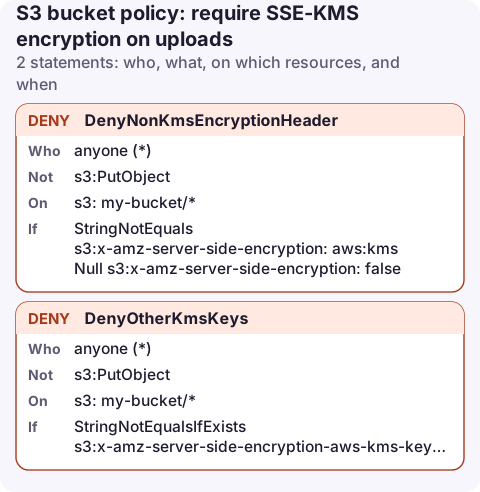
The policy
{
  "Version": "2012-10-17",
  "Statement": [
    {
      "Sid": "DenyNonKmsEncryptionHeader",
      "Effect": "Deny",
      "Principal": "*",
      "Action": "s3:PutObject",
      "Resource": "arn:aws:s3:::my-bucket/*",
      "Condition": {
        "StringNotEquals": {
          "s3:x-amz-server-side-encryption": "aws:kms"
        },
        "Null": {
          "s3:x-amz-server-side-encryption": "false"
        }
      }
    },
    {
      "Sid": "DenyOtherKmsKeys",
      "Effect": "Deny",
      "Principal": "*",
      "Action": "s3:PutObject",
      "Resource": "arn:aws:s3:::my-bucket/*",
      "Condition": {
        "StringNotEqualsIfExists": {
          "s3:x-amz-server-side-encryption-aws-kms-key-id": "arn:aws:kms:eu-west-2:123456789012:key/1234abcd-12ab-34cd-56ef-1234567890ab"
        }
      }
    }
  ]
}
Pair it with default encryption on the bucket:
aws s3api put-bucket-encryption --bucket my-bucket \
  --server-side-encryption-configuration '{"Rules":[{"ApplyServerSideEncryptionByDefault":{"SSEAlgorithm":"aws:kms","KMSMasterKeyID":"arn:aws:kms:eu-west-2:123456789012:key/1234abcd-12ab-34cd-56ef-1234567890ab"},"BucketKeyEnabled":true}]}'
What each statement does
DenyNonKmsEncryptionHeader has two conditions, and both must be true for the deny to apply: the x-amz-server-side-encryption header is present (Null is false) and its value is not aws:kms. An upload asking for AES256 is refused; an upload with no header passes and gets the bucket default, which is your KMS key.
DenyOtherKmsKeys refuses uploads that name a different KMS key. IfExists means requests that don't specify a key aren't affected, again leaving the bucket default to apply.
The classic version on many blogs uses only StringNotEquals without the Null check. That denies every upload that omits the header, which breaks clients relying on default encryption, including some AWS services that write logs to buckets.
Before you apply it
- Uploaders now need
kms:GenerateDataKeyon the key, and readers needkms:Decrypt. Grant them in IAM, or in the key policy for other accounts. See KMS decrypt policy. - Turn on S3 Bucket Keys (as in the command above). It sharply reduces KMS request volume and therefore KMS request charges for busy buckets.
- Existing objects keep their old encryption. Re-encrypting them needs a copy-in-place or S3 Batch Operations job.
- Services that deliver logs to buckets (for example ALB access logs) support only certain encryption types. Check the service's docs before forcing KMS on a log bucket.
Variations
- Require any encryption header at all (strict mode): drop the
Nullcondition. Only do this when you control every client. - DSSE-KMS: the header value is
aws:kms:dsse. Adjust the first statement if you use dual-layer encryption. - Deny SSE-C (customer-provided keys): add a deny on
s3:PutObjectwith"Null": {"s3:x-amz-server-side-encryption-customer-algorithm": "false"}.
Common mistakes
- Using the key alias in the key-ID condition. Clients may send the key ARN, key ID or alias, and the comparison is a literal string match. Standardise clients on the full key ARN, or rely on default encryption and don't send the header at all.
- Locking out readers. A bucket full of SSE-KMS objects is unreadable to anyone without
kms:Decrypt; check the key policy before switching defaults. - Forgetting multipart uploads. The encryption headers are evaluated on the request that starts the upload; the same deny covers it because that request is authorised as
s3:PutObject.
Questions
Do I still need a policy to deny unencrypted uploads to S3?
Not for encryption at rest in general: since January 2023 S3 encrypts all new objects with SSE-S3 by default. A policy is still useful to force SSE-KMS with a specific key.
Why are uploads without an encryption header being denied?
Your deny uses StringNotEquals on s3:x-amz-server-side-encryption without a Null check, so a missing header counts as not equal. Add the Null condition shown above.
If a writer starts failing after an encryption change, the error is usually a KMS AccessDenied in the application logs. Reading those logs from a phone is often enough to know whether to roll the bucket policy back.
About the app → · Download on the App Store