 CloudConsole
ap-northeast-2: Asia Pacific (Seoul)
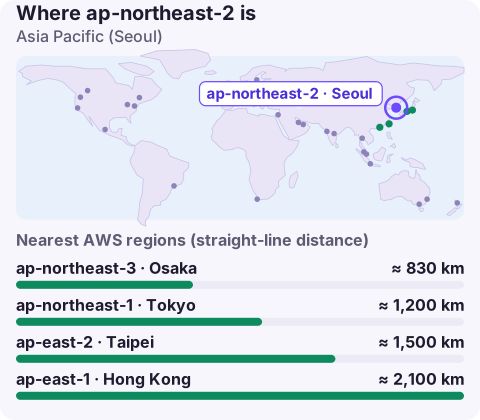
ap-northeast-2 is the code for the Asia Pacific (Seoul) region in South Korea. It is enabled by default and is the region for Korean users and for data that Korean customers or regulators expect to stay in Korea; it is widely used by games, fintech and e-commerce companies serving the Korean market.
Why teams run in Seoul
South Korea has very fast consumer broadband and users who notice lag, so latency is a genuine competitive factor here, not a nice-to-have. Typical reasons to pick ap-northeast-2:
- Online games and live services where every millisecond of round trip shows up in player experience.
- Fintech, banking and e-commerce with Korean customers, where domestic hosting simplifies compliance discussions under Korea's personal information protection rules.
- Public-sector and enterprise customers that ask for Korean hosting in procurement.
Korea's rules on transferring personal information abroad are stricter than many teams expect. If you plan to replicate Korean user data to Tokyo or a US region, get the legal position confirmed first.
Not every Korean product needs Seoul, though. A global SaaS tool with a modest Korean user base and no residency commitments can serve Korea acceptably from Tokyo, keeping one Asian region instead of two. The decision usually turns on whether your Korean customers ask the hosting question in procurement, and how interactive the product is.
Pointing tools at Seoul
aws ec2 describe-instances --region ap-northeast-2 \
  --query 'Reservations[].Instances[].[InstanceId,Placement.AvailabilityZone,State.Name]' \
  --output table

export AWS_REGION=ap-northeast-2
Endpoints follow <service>.ap-northeast-2.amazonaws.com. The three ap-northeast codes are Tokyo (1), Seoul (2) and Osaka (3). The numbering reflects launch order rather than geography, which is why people regularly guess wrong; name your profiles seoul, tokyo and osaka rather than relying on memory.
Capacity and instance types
Seoul is a well-established region, but game launches and shopping events create sharp, predictable spikes. Before a big launch:
- Confirm the instance families you need exist in each zone with
describe-instance-type-offerings. - Request quota increases (EC2 vCPU, Lambda concurrency, load balancer limits) well before launch day.
- Consider On-Demand Capacity Reservations for the peak, so an
InsufficientInstanceCapacityerror doesn't land during your launch window.
Disaster recovery options
There is one AWS region in South Korea, so in-country resilience means spreading across Availability Zones in Seoul and protecting backups in a separate account. If data may leave Korea, ap-northeast-1 (Tokyo) and ap-northeast-3 (Osaka) are the closest regions, with Tokyo offering the broader catalogue. Test the failover; replication alone doesn't prove you can run there. A realistic drill restores from backups into the recovery region, points a test domain at it and runs your smoke tests, which reveals the missing AMI, secret or quota long before a real event.
Nearby regions at a glance
| Region | Notes |
|---|---|
| ap-northeast-1 (Tokyo) | Largest nearby region; common DR partner |
| ap-northeast-3 (Osaka) | Geographically closest Japanese region |
| ap-east-1 (Hong Kong) | Opt-in; Greater China access from the standard partition |
| ap-southeast-1 (Singapore) | South-East Asian hub |
Before committing, check each managed service in your design on the AWS Regional Services List for both Seoul and your recovery region.
Questions
Where is ap-northeast-2?
In Seoul, South Korea.
Is ap-northeast-2 opt-in?
No. Seoul is enabled by default in every account.
What's the closest region to Seoul?
Osaka (ap-northeast-3) and Tokyo (ap-northeast-1) are the nearest; Tokyo has the larger service catalogue.
Game launches and sales events in Seoul tend to produce alarms at peak hours, not office hours. CloudConsole, a phone app for AWS, is built to show those alarms and the resources behind them on your phone.
About the app → · Download on the App Store