 CloudConsole
ap-northeast-3: Asia Pacific (Osaka)
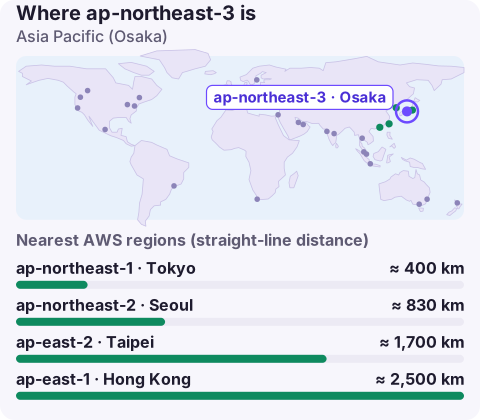
ap-northeast-3 is the code for the Asia Pacific (Osaka) region in Japan. It started as a limited "local region" and later became a full region, and today it is mostly used as the in-country disaster-recovery partner for Tokyo, or as a primary region for users in western Japan.
From local region to full region
Osaka originally opened as a single-zone "local region" with restricted access, designed only for customers who needed a second Japanese location for backup. It was later expanded into a standard multi-AZ region open to everyone. If you read older blog posts saying Osaka needs a special request or has one zone, they describe that earlier phase; check the current Availability Zones with the API instead.
One leftover from that history: some organisations still have internal documentation or SCP allow-lists written when Osaka was off-limits. If the region is missing from your deployment targets, look for an old policy excluding ap-northeast-3 before assuming AWS restricts it.
aws ec2 describe-availability-zones --region ap-northeast-3 \
  --query 'AvailabilityZones[].[ZoneName,ZoneId,State]' --output table
Using Osaka as Tokyo's recovery region
Japanese organisations often require that recovery data sits far enough from Tokyo to survive a major earthquake or regional disaster, while staying inside Japan. Osaka, several hundred kilometres away, satisfies both. A typical setup:
- Replicate S3 buckets from Tokyo with Cross-Region Replication.
- Copy EBS snapshots, AMIs and AWS Backup recovery points on a schedule; re-encrypt with KMS keys created in Osaka.
- Run database replicas cross-region where the engine supports it.
- Keep IAM roles, networking, parameters and secrets pre-provisioned in Osaka so the runbook doesn't depend on creating them during the disaster.
- Raise quotas in Osaka to match the capacity you'd need after failover.
Service coverage
Osaka's catalogue is smaller than Tokyo's. A recovery plan that assumes a service exists in both regions fails at the worst moment if it doesn't. Go through each managed service and specialised instance family in your Tokyo design and check it on the AWS Regional Services List or with describe-instance-type-offerings. Where something is missing, decide in advance on a substitute or accept that component's downtime.
Targeting ap-northeast-3
aws s3api create-bucket --bucket my-bucket-osaka-dr \
  --region ap-northeast-3 \
  --create-bucket-configuration LocationConstraint=ap-northeast-3

export AWS_REGION=ap-northeast-3
Endpoints follow <service>.ap-northeast-3.amazonaws.com. The number after ap-northeast reflects launch order, not location: 1 is Tokyo, 2 is Seoul and 3 is Osaka. A DR script that targets ap-northeast-2 by mistake sends Japanese data to Korea.
Choosing Osaka as a primary region
For a business based in the Kansai area (Osaka, Kyoto, Kobe) whose users are mainly in western Japan, Osaka can be a sensible primary, with Tokyo as the recovery region in reverse. The trade-off is the smaller catalogue: if your architecture leans on newer managed services, Tokyo as primary is usually simpler. Nearby alternatives outside Japan are ap-northeast-2 (Seoul) and ap-east-2 (Taipei).
Questions
Where is ap-northeast-3?
In Osaka, in western Japan.
Is ap-northeast-3 an opt-in region?
It isn't one of AWS's opt-in regions; it's available in accounts by default. If you can't see it, check for SCPs or IAM policies restricting regions.
Is Osaka a good DR region for Tokyo?
Yes, it's the standard in-country choice. Check that every service your Tokyo workload uses is available in Osaka before relying on it.
A failover to Osaka is exactly when you want both Japanese regions visible at once. CloudConsole, a phone app for AWS, is built to show alarms and resources across regions on your phone.
About the app → · Download on the App Store