 CloudConsole
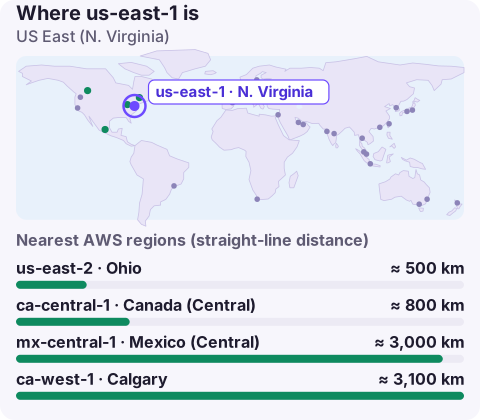
us-east-1: US East (N. Virginia)
us-east-1 is the code for the US East (N. Virginia) region, the original AWS region, with data centres in northern Virginia. It is enabled in every account, carries the widest service catalogue, and hosts several features that only work there, such as ACM certificates for CloudFront and the billing metrics in CloudWatch.
Why us-east-1 is different from every other region
Most regions are interchangeable apart from location and price. us-east-1 is not, because a number of global features are anchored to it:
- CloudFront certificates. An ACM certificate attached to a CloudFront distribution must be requested or imported in us-east-1, whatever region your origin is in.
- Lambda@Edge. Functions you associate with a distribution are created in us-east-1 and replicated from there.
- Billing metrics.
EstimatedChargesonly appears in CloudWatch in us-east-1, so a billing alarm has to be created there. - CloudFront and Route 53 health-check metrics are also published to CloudWatch in us-east-1.
- S3 legacy behaviour. The global endpoint
s3.amazonaws.comresolves to us-east-1, andcreate-bucketin us-east-1 must be called without aLocationConstraint; passingus-east-1explicitly is rejected. - Control planes. IAM, and the APIs for several other global services, have their control plane in us-east-1. Data-plane features such as authenticating requests keep working elsewhere, but changes to users, roles and policies depend on it.
That last point is why an incident in us-east-1 can be felt in accounts that run nothing there.
Checking us-east-1 status during an outage
When everything looks broken at once, separate a regional AWS event from your own fault before you start changing things:
- Open the public AWS Health Dashboard and filter for N. Virginia. AWS posts there once an event is confirmed, which can lag the first symptoms.
- Look at your account's view of AWS Health, which lists events that affect your specific resources.
- Compare against a resource in another region. If the same call works in us-east-2 or us-west-2, the problem is regional.
The Health API itself is served from us-east-1 (it needs a Business, Enterprise On-Ramp or Enterprise support plan):
aws health describe-events \
  --region us-east-1 \
  --filter eventStatusCodes=open \
  --query 'events[].[service,eventTypeCode,region,startTime]' \
  --output table
A step-by-step routine is in how to check whether AWS is down.
Targeting us-east-1 from the CLI and SDKs
Set it per command, per shell, or per profile:
# one command
aws ec2 describe-instances --region us-east-1

# the whole shell session
export AWS_REGION=us-east-1

# a named profile in ~/.aws/config
[profile prod-use1]
region = us-east-1
Regional endpoints follow the usual pattern, for example ec2.us-east-1.amazonaws.com or dynamodb.us-east-1.amazonaws.com. Some older SDKs and tools default to us-east-1 when no region is configured, which is a common reason resources turn up there by accident; find resources in all regions helps you spot strays.
Should you run production here?
Reasons to choose it: lowest latency to the US east coast, every new service and instance type tends to be available here early, and list prices are among the lowest. Reasons to hesitate: it is the busiest region, scarce instance types can run short, and its incidents get the most attention because so much depends on it.
A sensible middle ground is to keep the global pieces that must live here (certificates for CloudFront, billing alarms) in us-east-1 and run workloads wherever suits you, often us-east-2 or us-west-2. Whichever you choose, multi-AZ protects you against a data-centre failure, not a regional one; only a second region does that.
| Alternative | Why |
|---|---|
| us-east-2 (Ohio) | Close by, similar pricing for many services, a common DR pair |
| us-west-2 (Oregon) | Large and well-stocked, far enough away for disaster recovery |
| ca-central-1 (Canada) | When data must stay in Canada |
Questions
Where is us-east-1 located?
In northern Virginia, in the United States. AWS doesn't publish exact data-centre addresses, but the region is centred on the Washington DC metro area.
Why do I have to create my CloudFront certificate in us-east-1?
CloudFront is a global service and reads certificates from ACM in us-east-1 only. A certificate in any other region won't appear in the distribution settings.
How do I check if us-east-1 is down?
Check the public AWS Health Dashboard for N. Virginia and your account's AWS Health events, then try the same API call in a second region to confirm the problem is regional.
us-east-1 incidents rarely wait for office hours, and the first question is always whether it's AWS or you. CloudConsole, a phone app for AWS, is built to put your alarms and resource state across regions on one screen so you can tell quickly.
About the app → · Download on the App Store