 CloudConsole
gp3 vs gp2 (and when to use io2)
Use gp3 for almost every new and existing general-purpose volume: AWS prices it 20% lower per GiB than gp2 and it gives a steady 3,000 IOPS and 125 MiB/s at any size, with more available independently of capacity. Keep gp2 only where you have not migrated yet. Choose io2 Block Express when you need sub-millisecond latency, more than 80,000 IOPS, 99.999% durability or Multi-Attach.
gp3 vs gp2 vs io2
| Factor | gp3 | gp2 |
|---|---|---|
| Size | 1 GiB to 64 TiB | 1 GiB to 16 TiB |
| Baseline IOPS | 3,000 at any size | 3 IOPS per GiB (minimum 100), up to 16,000 |
| Burst | None needed; full performance sustained | Volumes under 1 TiB burst to 3,000 IOPS using I/O credits |
| Maximum IOPS | 80,000 (500 IOPS per GiB, reached at 160 GiB) | 16,000 (reached at 5,334 GiB) |
| Throughput | 125 MiB/s baseline, up to 2,000 MiB/s | 128 to 250 MiB/s depending on size |
| Price | 20% lower per GiB than gp2; pay extra only for IOPS above 3,000 and throughput above 125 MiB/s | Per GiB only; performance tied to size |
| Durability | 99.8% to 99.9% | 99.8% to 99.9% |
| io2 Block Express | Value |
|---|---|
| Size | Up to 64 TiB |
| IOPS | Up to 256,000, at up to 1,000 IOPS per GiB |
| Throughput | Up to 4,000 MiB/s |
| Durability | Designed for 99.999% |
| Latency | Consistent sub-millisecond |
| Multi-Attach | Supported (io1 and io2), same AZ |
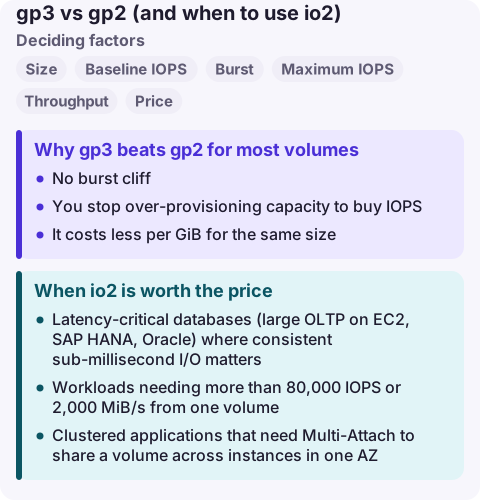
Why gp3 beats gp2 for most volumes
- No burst cliff. A small gp2 volume that runs out of I/O credits drops to its baseline (as low as 100 IOPS), which looks like a sudden database slowdown. gp3 has no credits to exhaust.
- You stop over-provisioning capacity to buy IOPS. On gp2, the only way to more IOPS is a bigger disk; on gp3 you set IOPS and throughput directly.
- It costs less per GiB for the same size.
Check throughput when converting large gp2 volumes: a gp2 volume of 334 GiB or more delivers 250 MiB/s, so a gp3 replacement should be given at least that throughput to avoid a regression.
When io2 is worth the price
- Latency-critical databases (large OLTP on EC2, SAP HANA, Oracle) where consistent sub-millisecond I/O matters.
- Workloads needing more than 80,000 IOPS or 2,000 MiB/s from one volume.
- Clustered applications that need Multi-Attach to share a volume across instances in one AZ.
- Data where the higher designed durability reduces risk enough to matter.
For most RDS and self-managed databases, start on gp3 with provisioned IOPS and move to io2 only if measured latency or IOPS limits require it.
Migrating gp2 to gp3
Elastic Volumes changes the type in place, without detaching the volume or stopping the instance. Performance stays available while the volume moves through the optimizing state.
# Find gp2 volumes
aws ec2 describe-volumes --filters Name=volume-type,Values=gp2 \
  --query 'Volumes[].[VolumeId,Size,Iops]' --output table

# Convert one, matching gp2 throughput on large volumes
aws ec2 modify-volume --volume-id vol-0123456789abcdef0 \
  --volume-type gp3 --iops 3000 --throughput 250

# Watch progress
aws ec2 describe-volumes-modifications --volume-ids vol-0123456789abcdef0
You can modify a volume up to four times in a rolling 24-hour period, and each change must complete before the next starts. For RDS, change the storage type on the instance rather than the underlying volumes.
Common wrong reasons
- "gp2 is fine because we never hit the limit." Check
BurstBalance: small volumes often drain credits at peak without anyone noticing until latency spikes. - "io2 is needed for production databases." Many run well on gp3 with provisioned IOPS at a fraction of the cost.
- "Converting needs downtime." It does not; it only takes time to optimise.
Questions
Is gp3 cheaper than gp2?
Yes. AWS prices gp3 20% lower per GiB than gp2, and its baseline 3,000 IOPS and 125 MiB/s are included. You pay extra only for IOPS or throughput above the baseline.
Is gp3 faster than gp2?
For volumes under about 1 TiB, yes in sustained terms: gp3 gives 3,000 IOPS at any size, while small gp2 volumes only burst to 3,000 until their credits run out.
Should RDS use gp3 or gp2?
Use gp3 for new RDS instances. Existing gp2 storage can be modified to gp3; check the instance's storage-modification status before making other storage changes.
An EBS volume that runs out of burst credits or hits its IOPS limit looks like an application slowdown, not a storage error. CloudConsole is being built to show volume and instance alarms on a phone with production guardrails.
About the app → · Download on the App Store