 CloudConsole
SQS vs SNS
Use SQS when one consumer group should process each message, at its own pace, with retries and up to 14 days of buffering. Use SNS when one event must be pushed to many subscribers at once (queues, Lambda functions, HTTPS endpoints, email or SMS). Most production designs combine them: publish to an SNS topic and subscribe one SQS queue per consuming service.
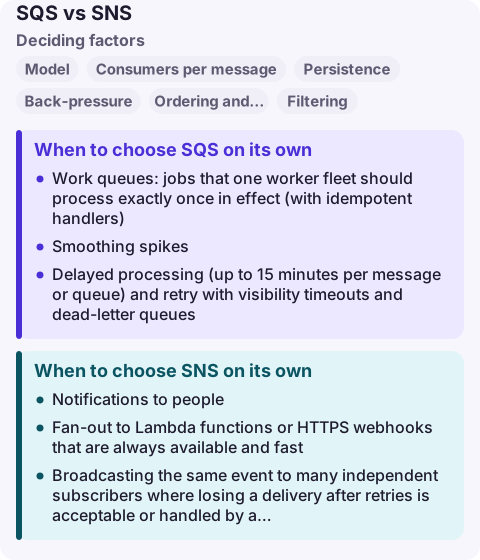
SQS vs SNS compared
| Factor | Amazon SQS | Amazon SNS |
|---|---|---|
| Model | Queue: consumers poll and delete | Topic: SNS pushes to every subscription |
| Consumers per message | One (whoever receives and deletes it) | Every matching subscriber |
| Persistence | 4 days by default, 1 minute to 14 days | No storage; delivery is attempted with retries, then optional DLQ |
| Back-pressure | Natural: messages wait until consumers catch up | None: subscribers must keep up or buffer (usually in SQS) |
| Ordering and de-duplication | FIFO queues | FIFO topics (to SQS queues) |
| Filtering | None per message (consumers take what is there) | Filter policies on attributes or message body, per subscription |
| Max message size | 1 MiB | 256 KiB by default, configurable up to 1 MiB |
| Destinations | Your consumers, Lambda event source mappings, EventBridge Pipes | SQS, Lambda, HTTP(S), email, SMS, mobile push, Firehose |
When to choose SQS on its own
- Work queues: jobs that one worker fleet should process exactly once in effect (with idempotent handlers).
- Smoothing spikes: producers burst, consumers drain at a steady, controlled rate.
- Delayed processing (up to 15 minutes per message or queue) and retry with visibility timeouts and dead-letter queues.
- Decoupling two services where the consumer may be down for maintenance without losing messages.
When to choose SNS on its own
- Notifications to people: email, SMS or mobile push from alarms and applications.
- Fan-out to Lambda functions or HTTPS webhooks that are always available and fast.
- Broadcasting the same event to many independent subscribers where losing a delivery after retries is acceptable or handled by a DLQ.
Using both: the fan-out pattern
Publish once to an SNS topic, subscribe an SQS queue per downstream service, and let each service consume from its own queue. Each consumer gets durable buffering, its own retries and dead-letter queue, and can be offline without affecting the others. Add filter policies on each subscription so a service only receives the event types it cares about.
Enable raw message delivery on SQS subscriptions if you do not want the SNS JSON envelope around your payload, and grant the topic sqs:SendMessage in the queue policy (scoped with aws:SourceArn). For ordered fan-out, use an SNS FIFO topic with SQS FIFO queues.
If you need routing on complex event content, many sources or third-party SaaS events, compare EventBridge as the router instead of SNS.
Common wrong reasons
- "SNS is a queue." It does not hold messages for consumers to fetch later. If nobody can receive, the message is retried and eventually dropped or sent to a DLQ.
- "SQS can fan out by having several consumers." Multiple consumers on one queue compete for messages; each message goes to one of them.
- "Standard queues lose messages." They are at-least-once with best-effort ordering. Duplicates, not losses, are what you design for.
Questions
Can SQS and SNS be used together?
Yes, and it is the most common pattern: an SNS topic fans out to several SQS queues, one per consuming service, each with its own retries and dead-letter queue.
Does SNS store messages?
No. SNS pushes messages to subscribers and retries failed deliveries according to its delivery policy; it does not keep messages for later polling.
How long does SQS keep messages?
4 days by default, configurable from 60 seconds to 14 days.
Queue problems surface as age of the oldest message climbing or a dead-letter queue filling up, often hours before customers notice. CloudConsole is being built to show those alarms and let you inspect queues on a phone with production guardrails.
About the app → · Download on the App Store