 CloudConsole
CloudWatch alarm: PrivateLink (AWS/PrivateLinkServices) RstPacketsSent
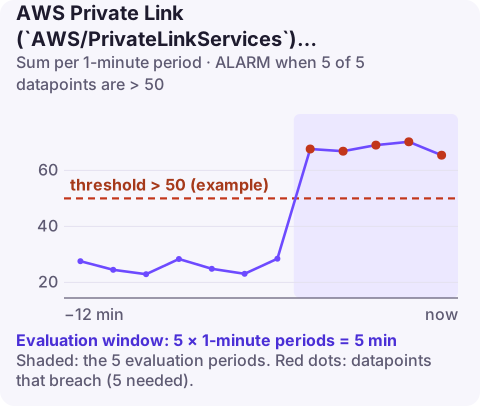
Alarm on AWS/PrivateLinkServices RstPacketsSent with the Service Id, Load Balancer Arn and Az dimensions, Sum over 60 seconds, above your threshold for 5 consecutive minutes. If you run an endpoint service, a rise in reset packets sent to consumers usually means targets behind your Network Load Balancer are unhealthy or closing connections.
Who this alarm is for
This metric lives on the provider side of PrivateLink: the account that owns the endpoint service and its load balancer. RstPacketsSent counts TCP reset packets sent from the service towards consumer endpoints. Resets abruptly end connections, so consumers see "connection reset by peer" errors.
It is especially useful when a consumer reports errors and you need to know which side is at fault. If this metric is flat while the consumer sees failures, the problem is elsewhere on the path (their endpoint, DNS, security groups). If it spikes, your service is the one cutting connections.
Common causes: targets failing health checks or being deregistered, application processes crashing or restarting, connections to a target that is draining, and long-lived idle connections that exceed the load balancer's idle timeout.
Recommended alarm settings
| Setting | Recommended value |
|---|---|
| Namespace | AWS/PrivateLinkServices |
| Metric | RstPacketsSent |
| Dimensions | Service Id, Load Balancer Arn, Az |
| Statistic | Sum |
| Threshold | Depends on your situation (depends on tolerance for unhealthy targets) |
| Period | 60 seconds |
| Datapoints to alarm | 5 |
| Evaluation periods | 5 |
| Comparison operator | GreaterThanThreshold |
There is one series per load balancer and Availability Zone. Dimension names contain spaces; copy values exactly from aws cloudwatch list-metrics --namespace AWS/PrivateLinkServices --metric-name RstPacketsSent.
Setting the threshold
- Low tolerance: services where every reset is a failed customer request (payments, auth). Set the threshold just above the normal background seen over two weeks, which is often close to zero.
- High tolerance: services whose clients reconnect and retry automatically, or where deploys cause expected bursts of resets. Set the threshold above the deploy-time peak, or use a longer evaluation window.
- Compare the value with
NewConnectionsfor the same service; a reset rate of a few percent of new connections is a more stable signal than a raw count when traffic varies.
Create the alarm
aws cloudwatch put-metric-alarm \
  --alarm-name vpce-svc-orders-rst-az-a \
  --alarm-description "orders endpoint service sending resets in eu-west-2a" \
  --namespace AWS/PrivateLinkServices \
  --metric-name RstPacketsSent \
  --dimensions "Name=Service Id,Value=vpce-svc-0123456789abcdef0" "Name=Load Balancer Arn,Value=arn:aws:elasticloadbalancing:eu-west-2:123456789012:loadbalancer/net/orders-nlb/0123456789abcdef" Name=Az,Value=eu-west-2a \
  --statistic Sum \
  --period 60 \
  --evaluation-periods 5 \
  --datapoints-to-alarm 5 \
  --threshold 50 \
  --comparison-operator GreaterThanThreshold \
  --treat-missing-data notBreaching \
  --alarm-actions arn:aws:sns:eu-west-2:123456789012:oncall-alerts
The threshold of 50 is an example. Use the load balancer value exactly as list-metrics prints it.
When it fires
- Check target health on the NLB's target groups. Unhealthy or draining targets are the most common source.
- Look for restarts: recent deploys, crashing containers or instances being replaced in that AZ.
- Check idle timeouts: if consumers keep idle connections open for long periods, enable TCP keep-alives on clients or targets.
- Tell consumers what you found; they will be seeing errors on their side and may be investigating their own network.
Questions
What is RstPacketsSent in PrivateLink?
The number of TCP reset packets an endpoint service sent to consumer endpoints. Resets close connections abruptly, so consumers see connection reset errors.
Can consumers see this metric?
No. It is published in the service provider's account. Consumers see endpoint-side metrics such as PacketsDropped instead.
When a consumer says your service is resetting connections, you want the answer before you reach a laptop. CloudConsole, a phone app for AWS, is built to show this alarm and its history on your phone.
Did it start after a deploy? What changed? on the app’s alarm screen lists the deploys and configuration changes from the hour before the alarm fired.
About the app → · Download on the App Store