 CloudConsole
Amazon ElastiCache pricing explained
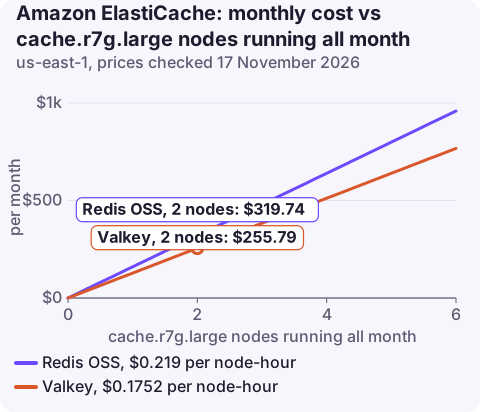
Node-based ElastiCache bills each cache node per hour by type and engine: a cache.r7g.large is $0.1752 per hour on Valkey and $0.219 on Redis OSS in us-east-1 at the time of writing. ElastiCache Serverless instead bills data stored per GB-hour ($0.084 for Valkey) plus ElastiCache Processing Units (ECPUs) for requests ($0.0023 per million for Valkey).
Pricing dimensions
| Dimension | Valkey | Redis OSS |
|---|---|---|
| cache.t4g.medium, per node-hour | $0.052 | $0.065 |
| cache.r7g.large, per node-hour | $0.1752 | $0.219 |
| Serverless data stored, per GB-hour | $0.084 | $0.125 |
| Serverless ECPUs, per million | $0.0023 | $0.0034 |
| Backup storage beyond the free allowance, per GB-month | $0.085 | |
From the AWS Price List API at the time of writing. Memcached nodes are priced like Redis OSS for these types. A simple GET or SET of up to 1 KB uses one ECPU; larger values and heavier commands use more.
Worked examples
1. A primary and one replica. Two cache.r7g.large nodes all month:
- Valkey: 2 × 730 × $0.1752 = $255.79
- Redis OSS: 2 × 730 × $0.219 = $319.74
- Moving the same cluster to Valkey saves $63.95 a month with no code change for most Redis clients.
2. A dev cache. One cache.t4g.medium on Valkey: 730 × $0.052 = $37.96.
3. Serverless Valkey. 2 GB stored on average and 500 million ECPUs in the month:
- Storage: 2 × 730 × $0.084 = $122.64
- Requests: 500 × $0.0023 = $1.15
- Total: $123.79. Storage dominates; a node-based cache of similar size can be cheaper for steady, predictable load.
Choosing nodes or serverless
Serverless scales automatically and suits spiky or unpredictable traffic, and each serverless cache bills a minimum amount of stored data even when nearly empty. Node-based clusters are cheaper for steady load and can use reserved nodes for a further discount. In both models, replicas are what give you availability, and each replica node is billed in full.
Charges that get missed
- Replicas per shard: a cluster with 3 shards and 2 replicas each is 9 nodes.
- Cross-AZ traffic between your application and a cache node in another Availability Zone.
- Snapshots retained beyond the free allowance.
- Extended Support fees on old Redis OSS engine versions past their end of standard support.
- Oversized nodes chosen for peak memory that only occurs during a cache warm-up.
Data tiering and reserved nodes
For large datasets, nodes with data tiering keep frequently accessed keys in memory and move less-used ones to local SSD, which lowers the cost per GB stored compared with memory-only nodes. Reserved nodes give a lower node-hour price for a one- or three-year term and are the usual way to cut the cost of a steady production cluster.
Seeing ElastiCache cost
Filter Cost Explorer to ElastiCache and group by Usage type: node-hours appear as NodeUsage:cache.r7g.large; serverless as USE1-CachedData:Valkey and USE1-ElastiCacheProcessingUnits:Valkey. The BytesUsedForCache and ElastiCacheProcessingUnits CloudWatch metrics show what drives each line.
Questions
Is ElastiCache for Valkey cheaper than Redis OSS?
Yes. In us-east-1 at the time of writing, node prices for Valkey are about 20% lower (cache.r7g.large $0.1752 against $0.219 per hour) and serverless storage is $0.084 against $0.125 per GB-hour.
How much does ElastiCache Serverless cost?
For Valkey, $0.084 per GB-hour of data stored plus $0.0023 per million ECPUs in us-east-1, at the time of writing, with a minimum amount of data billed per cache.
How much is an ElastiCache node per month?
A cache.t4g.medium on Valkey is about $37.96 a month and a cache.r7g.large about $127.90, in us-east-1 at the time of writing.
Cache evictions and a memory alarm tend to arrive together. CloudConsole is being built to show alarms and costs on a phone.
About the app → · Download on the App Store