 CloudConsole
AWS KMS pricing explained
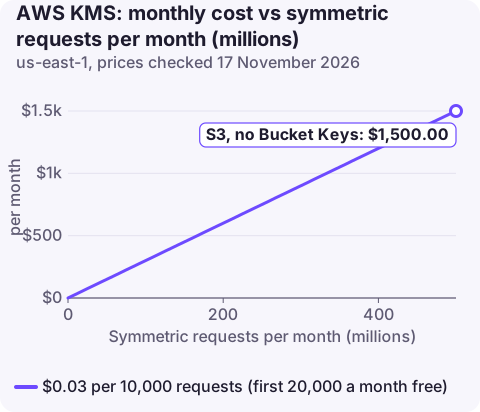
Each customer managed KMS key costs $1.00 a month and API requests cost $0.03 per 10,000 for symmetric keys after 20,000 free requests a month, in us-east-1 at the time of writing. AWS managed keys (aws/s3, aws/ebs) have no monthly fee, but requests made with them are billed the same way.
Pricing dimensions
| Dimension | Unit | us-east-1 price |
|---|---|---|
| Customer managed key | key-month | $1.00 |
| Symmetric requests (Encrypt, Decrypt, GenerateDataKey) | 10,000 | $0.03 |
| Asymmetric requests other than RSA 2048 | 10,000 | $0.15 |
| Free tier | requests a month | 20,000 |
From the AWS Price List API at the time of writing. The key charge is prorated by the hour. With automatic rotation, the first and second rotations each add to the key's monthly charge and later rotations are free; multi-Region replica keys are billed as separate keys.
Worked examples
1. A typical account. 10 customer managed keys and 2 million requests: 10 × $1.00 = $10.00 plus (2,000,000 − 20,000) × $0.000003 = $5.94, $15.94 a month.
2. S3 without Bucket Keys. A bucket using SSE-KMS serving 500 million PUTs and GETs a month makes roughly one KMS request per object operation: 500,000,000 × $0.000003 = $1,500.00. Turning on S3 Bucket Keys lets S3 reuse a bucket-level data key and can cut those requests by up to 99%.
3. One key per tenant. 1,000 tenant keys cost 1,000 × $1.00 = $1,000.00 a month before any requests. Consider encryption context per tenant on a shared key unless isolation rules require separate keys.
What is free
- AWS managed keys and AWS owned keys have no monthly charge.
- The first 20,000 requests a month across the account.
- Requests made by some AWS services on your behalf with keys they own (for example SQS-managed or S3-managed encryption) do not touch your KMS bill.
Charges people miss
- Chatty clients: SDKs that call Decrypt on every request instead of caching data keys.
- DynamoDB, SQS or SNS with customer managed keys, each calling KMS as they encrypt and decrypt.
- Cross-account use: requests are billed to the account that owns the key.
- Orphaned keys from deleted stacks, each still $1.00 a month until scheduled for deletion.
Estimating requests before they happen
KMS requests come from envelope encryption: a service asks KMS for a data key (GenerateDataKey) when it writes and for a decrypt (Decrypt) when it reads, unless it caches the data key. So request volume roughly follows object writes and reads for S3 without Bucket Keys, message sends and receives for SQS and SNS with customer managed keys, and session starts for services that cache. Multiply those counts by the request price to estimate the KMS line before switching a busy workload from an AWS managed key to a customer managed key.
Seeing KMS cost
Group Cost Explorer by Usage type under Key Management Service: us-east-1-KMS-Keys and us-east-1-KMS-Requests. CloudTrail records every KMS call, so a Logs Insights or Athena query on eventSource = kms.amazonaws.com grouped by userIdentity.arn finds the caller behind a request spike.
Cutting it: reducing KMS cost.
Questions
How much does a KMS key cost?
$1.00 per customer managed key per month in us-east-1 at the time of writing, prorated by the hour. AWS managed keys have no monthly fee.
How much do KMS requests cost?
$0.03 per 10,000 symmetric requests after 20,000 free a month; most asymmetric operations are $0.15 per 10,000.
Does KMS key rotation cost extra?
The first and second rotations each add to the key's monthly charge; further rotations are not charged.
Are AWS managed keys free?
They have no monthly fee, but requests that use them count toward request charges.
KMS throttling during an incident looks like an application error at first. CloudConsole is being built to show alarms and logs together on a phone.
About the app → · Download on the App Store