 CloudConsole
Secrets Manager vs Parameter Store: cost
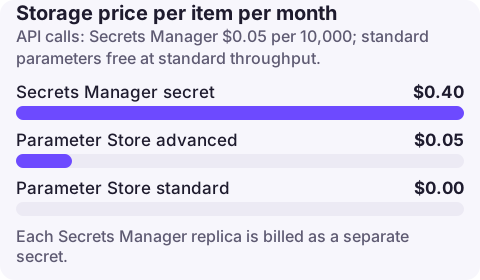
Secrets Manager charges per secret per month (the pricing example uses $0.40, prorated hourly, with each replica billed as a separate secret) plus $0.05 per 10,000 API calls. Parameter Store standard parameters, including SecureString, are free at standard throughput; advanced parameters cost $0.05 per parameter per month, and higher throughput bills $0.05 per 10,000 API interactions. Pay for Secrets Manager when you need managed rotation, cross-Region replication or resource policies.
Side by side
| Secrets Manager | Parameter Store standard | Parameter Store advanced | |
|---|---|---|---|
| Storage | Per secret per month | Free | $0.05 per parameter per month |
| API calls | $0.05 per 10,000 | Free at standard throughput | Billed per interaction |
| Higher throughput | Not applicable | $0.05 per 10,000 interactions once enabled | Same |
| Limits | Secret value up to 64 KB | 10,000 parameters, 4 KB values | 100,000 parameters, 8 KB values, parameter policies |
| Built-in rotation | Yes, including managed rotation for RDS and others | No | No (expiry policies only) |
| Cross-Region replication | Yes (replicas billed) | No | No |
Prices from the Secrets Manager and Systems Manager pricing pages at the time of writing. A Parameter Store "API interaction" counts each parameter returned: a GetParametersByPath call returning ten parameters is ten interactions.
Costs people miss
- KMS: both services encrypt with KMS. The AWS managed keys are free to keep, but a customer managed key costs $1 a month plus requests on every decrypt (KMS cost).
- Read volume: a Lambda function that fetches its secret on every invocation can turn a $0.40 secret into a large API bill. Cache values in the execution environment, or use the AWS Parameters and Secrets Lambda Extension.
- Enabling higher throughput in Parameter Store makes every interaction billable, including standard parameters, for the whole account and Region.
- Replicas of a Secrets Manager secret each pay the per-secret price.
Check what you have
# Secrets, with last accessed date (unused secrets still bill)
aws secretsmanager list-secrets \
  --query 'SecretList[].[Name,LastAccessedDate,RotationEnabled]' --output table

# Advanced parameters (the billed ones)
aws ssm describe-parameters \
  --parameter-filters Key=Tier,Values=Advanced \
  --query 'Parameters[].[Name,Tier,LastModifiedDate]' --output table

# Is higher throughput enabled in this Region?
aws ssm get-service-setting \
  --setting-id arn:aws:ssm:eu-west-2:123456789012:servicesetting/ssm/parameter-store/high-throughput-enabled
Choosing and reducing
- Use Parameter Store standard SecureString for configuration and secrets you rotate yourself or rarely.
- Use Secrets Manager for database credentials with managed rotation, secrets shared across accounts by resource policy, or secrets replicated to a DR Region.
- Delete secrets nobody has accessed in months, after checking with owners; deletion has a recovery window (7 to 30 days).
- Leave Parameter Store higher throughput off unless you are being throttled.
What not to do: move RDS credentials from Secrets Manager to Parameter Store to save $0.40 and lose automatic rotation; the saving rarely justifies the risk.
Questions
Is Parameter Store free?
Standard parameters, including SecureString, are free at standard throughput. Advanced parameters and higher throughput are charged.
How much does a Secrets Manager secret cost?
The pricing page example uses $0.40 per secret per month, prorated hourly, plus $0.05 per 10,000 API calls.
Is Secrets Manager worth the cost?
When you need managed rotation, cross-Region replication or resource-based sharing, usually yes. For static configuration, Parameter Store standard is cheaper.
Secret costs are small until a hot code path starts fetching on every request. CloudConsole, a phone app for AWS, shows spend by service and usage type, so a rise in Secrets Manager API calls is visible from your phone.
About the app → · Download on the App Store