 CloudConsole
S3 Intelligent-Tiering cost
S3 Intelligent-Tiering charges the storage rate of whichever access tier each object is in, plus a small monthly monitoring and automation fee per object of 128 KB or more. Objects move to cheaper tiers after 30 and 90 days without access and back on access, with no retrieval fees. It saves money for large objects with unknown or changing access; for tiny or short-lived objects the fee or the frequent tier can make it no cheaper than Standard.
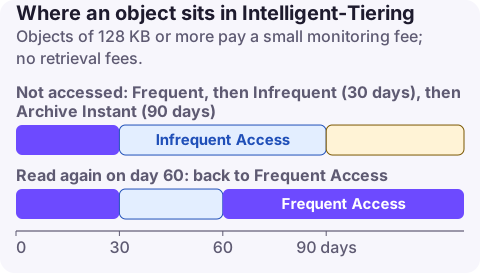
How it is billed
| Component | Usage type | Notes |
|---|---|---|
| Frequent Access tier | TimedStorage-INT-FA-ByteHrs | New and recently accessed objects |
| Infrequent Access tier | TimedStorage-INT-IA-ByteHrs | After 30 consecutive days without access |
| Archive Instant Access tier | TimedStorage-INT-AIA-ByteHrs | After 90 consecutive days without access |
| Archive Access / Deep Archive Access | TimedStorage-INT-AA-ByteHrs, -INT-DAA-ByteHrs | Optional; you opt in and set 90 to 730 / 180 to 730 days |
| Monitoring and automation | Monitoring-Automation-INT | Per 1,000 objects monitored per month |
| Requests | Requests-INT-Tier1, -Tier2 | Plus a Tier4 transition request per object moved in by lifecycle |
Objects under 128 KB are never monitored or moved: they stay in Frequent Access and carry no monitoring fee. Retrievals and standard or bulk restores are free in every tier.
When it pays off and when it does not
- Good fit: data lakes, user uploads and media where some objects are hot and most go cold, objects mostly over 1 MB, kept for months.
- Poor fit: buckets of tiny objects (no tiering, no saving), data deleted within 30 days (never reaches a cheaper tier), and data read constantly (stays in Frequent Access while still paying the monitoring fee).
- Versus Standard-IA: IA is cheaper only if you are sure access is rare; one busy month of reads on IA adds retrieval fees that Intelligent-Tiering would not charge.
A useful estimate: monitoring fee per object per month versus the storage saving per object once it reaches the Infrequent tier. For large objects the saving dominates; for objects of a few hundred KB the margin is thin.
Turn it on
Upload with storage class INTELLIGENT_TIERING, or transition existing objects with a lifecycle rule. Archive tiers are opt-in per bucket or prefix:
# Opt a prefix into the Deep Archive Access tier after 180 days without access
aws s3api put-bucket-intelligent-tiering-configuration --bucket my-bucket \
  --id archive-old-media \
  --intelligent-tiering-configuration '{
    "Id": "archive-old-media",
    "Filter": {"Prefix": "media/"},
    "Status": "Enabled",
    "Tierings": [{"Days": 180, "AccessTier": "DEEP_ARCHIVE_ACCESS"}]
  }'
Objects in the opt-in archive tiers must be restored before they can be read, so only enable them for data where a delay of hours is acceptable.
Check it is working
- After 30 to 90 days, Cost Explorer grouped by usage type should show storage moving from
INT-FAtoINT-IAandINT-AIA. - The
BucketSizeBytesmetric has storage types for each tier (for exampleIntelligentTieringFAStorageandIntelligentTieringIAStorage). - If nearly everything stays in Frequent Access, something is reading it: a scanner, a backup tool or an analytics job.
Questions
Does S3 Intelligent-Tiering have retrieval fees?
No. There are no retrieval fees, and standard and bulk restores from the archive tiers are free.
Is there a minimum object size for Intelligent-Tiering?
Objects of any size can be stored, but only objects of 128 KB or more are monitored and auto-tiered; smaller ones stay in Frequent Access with no monitoring fee.
Does moving objects into Intelligent-Tiering cost money?
Lifecycle transitions into Intelligent-Tiering are billed per request, so moving very many small objects has an up-front cost.
Intelligent-Tiering savings arrive slowly, tier by tier. CloudConsole, a phone app for AWS, shows S3 spend by usage type and explains the INT-FA, INT-IA and monitoring lines, so you can confirm the shift from your phone.
About the app → · Download on the App Store