 CloudConsole
S3 Requests-Tier1 and Requests-Tier2
Requests-Tier1 is the S3 usage type for PUT, COPY, POST and LIST requests (plus tagging) against S3 Standard, and Requests-Tier2 covers GET and all other requests. Both are billed per 1,000 requests, Tier1 at a higher rate. DELETE and CANCEL requests are free. A large Tier1 line almost always means many small writes or a process listing a bucket over and over.
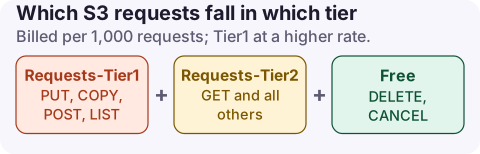
What each tier covers
| Usage type | Requests |
|---|---|
Requests-Tier1 | PUT, COPY, POST on S3 Standard objects and tags, plus LIST on any bucket |
Requests-Tier2 | GET, HEAD and all other non-Tier1 requests |
Requests-SIA-Tier1, -GIR-Tier1, -INT-Tier1 | Writes to Standard-IA, Glacier Instant Retrieval, Intelligent-Tiering |
Requests-Tier3 | Lifecycle transitions into Glacier Flexible Retrieval or Deep Archive, and standard restores |
Requests-Tier4 | Lifecycle transitions into Glacier Instant Retrieval, Intelligent-Tiering, Standard-IA or One Zone-IA |
LIST is charged at the Tier1 rate for every storage class. Browsing a bucket in the S3 console makes real GET and LIST requests and is billed the same as API calls. Prefixes follow the usual rule: USW2-Requests-Tier1 is us-west-2, no prefix is us-east-1.
Common causes of a high request bill
- Polling with LIST to discover new objects, every few seconds, from many workers.
- Many tiny objects: per-event JSON files, small Parquet partitions, thumbnails. Request cost scales with object count, not size.
- Backup or sync tools that list or HEAD the whole bucket on every run (
aws s3 syncover millions of keys does this). - Lifecycle transitions of small objects, which add a Tier3 or Tier4 request per object.
- A hot public object served straight from S3 rather than through a cache.
Find the bucket and the caller
# Which request usage types, and how many requests, this month
aws ce get-cost-and-usage --region us-east-1 \
  --time-period Start=2026-11-01,End=2026-11-17 \
  --granularity MONTHLY --metrics UnblendedCost UsageQuantity \
  --filter '{"Dimensions":{"Key":"SERVICE","Values":["Amazon Simple Storage Service"]}}' \
  --group-by Type=DIMENSION,Key=USAGE_TYPE Type=DIMENSION,Key=OPERATION \
  --query 'ResultsByTime[0].Groups[?contains(Keys[0], `Requests`)].[Keys[0],Keys[1],Metrics.UsageQuantity.Amount,Metrics.UnblendedCost.Amount]' \
  --output table
The Operation column (for example ListBucket or PutObject) shows which call dominates. To tie it to a bucket, use Cost Explorer resource-level data or a cost allocation tag on buckets. To find the caller, enable server access logging or CloudTrail data events on that bucket for a short window; both add their own cost, so turn them off afterwards.
Reduce it
- Replace LIST polling with S3 Event Notifications to SQS, SNS, Lambda or EventBridge.
- Batch small records into larger objects before writing; compact small files in data lakes.
- Use S3 Inventory for audits and reconciliation instead of listing the bucket; it is billed per million objects listed in the report.
- Put CloudFront in front of frequently read objects so repeat GETs hit the cache.
- Keep small objects out of transition rules; S3 by default does not transition objects under 128 KB, and overriding that is rarely worth it.
What not to do: add retries with no backoff when S3 returns throttling errors. Each retry is another billed request.
Questions
What is Requests-Tier1 in S3?
The usage type for PUT, COPY, POST and LIST requests against S3 Standard (and tagging), billed per 1,000 requests.
Are S3 DELETE requests free?
Yes. The S3 pricing page lists DELETE and CANCEL requests as free.
Does browsing the S3 console cost money?
Yes, a little. The console makes GET and LIST requests that are billed at the normal request rates.
Request charges can jump overnight when a new job starts polling a bucket. CloudConsole, a phone app for AWS, shows spend by usage type and explains Requests-Tier1 and Tier2, so a new request pattern is easy to spot.
About the app → · Download on the App Store