 CloudConsole
Amazon Route 53 limits and quotas
An account can create 500 hosted zones and 200 active health checks by default, and each hosted zone holds up to 10,000 records (more is possible, at extra charge). A single ChangeResourceRecordSets request can contain at most 1,000 ResourceRecord elements and 32,000 characters of values, with UPSERT counting double. API calls are throttled per account; throttled calls return HTTP 400 with the code Throttling, and changes to a zone that is still processing a previous change return PriorRequestNotComplete.
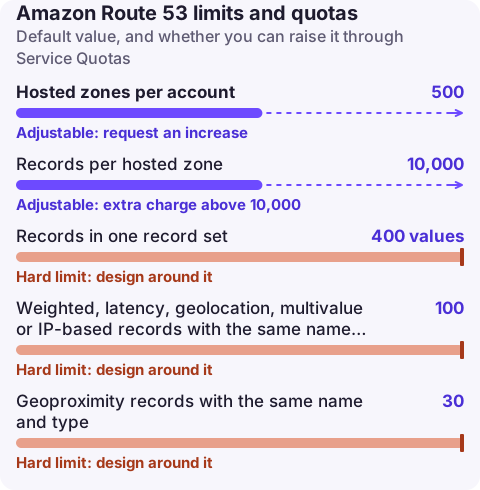
Entity quotas
| Quota | Default | Adjustable |
|---|---|---|
| Hosted zones per account | 500 | Yes |
| Records per hosted zone | 10,000 | Yes (extra charge above 10,000) |
| Records in one record set | 400 values | No |
| Weighted, latency, geolocation, multivalue or IP-based records with the same name and type | 100 | No |
| Geoproximity records with the same name and type | 30 | No |
| Active health checks per account | 200 | Yes |
| VPCs associated with one private hosted zone | 300 | Use Route 53 Profiles beyond that |
| Domains registered per account | 20 for accounts created since March 2021 | Yes |
| Reusable delegation sets | 100 | Yes |
| Traffic policies | 50 | Yes |
# Records used and the quota for one hosted zone
aws route53 get-hosted-zone-limit --type MAX_RRSETS_BY_ZONE --hosted-zone-id Z0123456789ABCDEFGHIJ

# Account-level counts and limits
aws route53 get-account-limit --type MAX_HOSTED_ZONES_BY_OWNER
aws route53 get-account-limit --type MAX_HEALTH_CHECKS_BY_OWNER
Each response returns both the limit and the current count, which is quicker than counting records yourself.
Change batch limits
A ChangeResourceRecordSets request is limited to:
- 1,000 ResourceRecord elements, alias records included. With
UPSERTeach one counts twice, so an UPSERT batch tops out at 500. - 32,000 characters across all
Valueelements, again doubled for UPSERT. Long TXT records (DKIM keys, verification strings) use this up fast.
Exceeding either returns InvalidChangeBatch. Split large migrations into several batches and wait for each to reach INSYNC before sending the next if they touch the same zone.
API request limits
Route 53 throttles API calls per account with two independent limits: request rate, and the number of individual record changes per second across all actions that modify DNS data. When either is exceeded the call fails with HTTP 400, Code: Throttling, Message: Rate exceeded. Separately, if a zone is still processing a previous change, further ChangeResourceRecordSets calls to that zone get PriorRequestNotComplete.
Practical consequences:
- Infrastructure-as-code tools that manage hundreds of records in parallel (Terraform with high parallelism, many stacks deploying at once) hit
Throttling; lower parallelism or batch changes into fewer requests. - ExternalDNS and similar controllers should batch updates and use a sensible sync interval.
- Route 53 Resolver APIs (VPC Resolver) are limited to five requests per second per account per Region.
- DNS query volume itself is not a quota for public hosted zones; Resolver endpoints in VPCs have per-IP query limits instead.
aws route53 change-resource-record-sets --hosted-zone-id Z0123456789ABCDEFGHIJ --change-batch file://batch-001.json
aws route53 wait resource-record-sets-changed --id C0123456789ABCDEFGHIJ
Design notes
- Large numbers of similar names (per-customer subdomains) can use a wildcard record instead of individual records.
- Keep record sets under the 100-records-per-name limit for weighted and latency routing by grouping endpoints behind load balancers.
- Health checks are a common reason to ask for more than 200; calculated health checks and CloudWatch-alarm health checks reduce the count.
Questions
How many records can a Route 53 hosted zone have?
10,000 records per hosted zone by default. You can request more, and records above 10,000 carry an additional charge.
How many hosted zones can I create in Route 53?
500 per account by default, adjustable through Service Quotas or a support request.
What is the Route 53 change batch limit?
1,000 ResourceRecord elements and 32,000 characters of values per ChangeResourceRecordSets request, with UPSERT changes counted twice.
DNS automation tends to fail in bulk, for example when a deploy updates hundreds of records at once. CloudConsole, a phone app for AWS, is being built to show health check alarms and failed deployments on your phone.
About the app → · Download on the App Store