 CloudConsole
API Gateway REST API vs HTTP API
Use an HTTP API for straightforward Lambda or HTTP proxy APIs that need JWT or IAM auth and CORS: it has fewer features and AWS prices it lower. Use a REST API if you need any of AWS WAF, API keys and usage plans, per-client throttling, request validation, caching, private (VPC-only) or edge-optimised endpoints, X-Ray tracing or execution logs.
Feature differences that decide it
| Feature | REST API | HTTP API |
|---|---|---|
| Endpoint types | Edge-optimised, Regional, private | Regional only |
| AWS WAF | Yes | No |
| API keys, usage plans, per-client throttling | Yes | No |
| Native JWT authoriser | No (use a Lambda authoriser) | Yes |
| IAM, Cognito, Lambda authorisers | Yes | Yes (Cognito through the JWT authoriser) |
| Resource policies | Yes | No |
| Caching | Yes | No |
| Request validation, body transformation, mocks | Yes | No |
| Automatic deployments | No | Yes |
| Canary deployments | Yes | No |
| X-Ray, execution logs | Yes | No (access logs and metrics only) |
| Integration timeout | 50 ms to 29 s (raisable for Regional and private) | Up to 30 s |
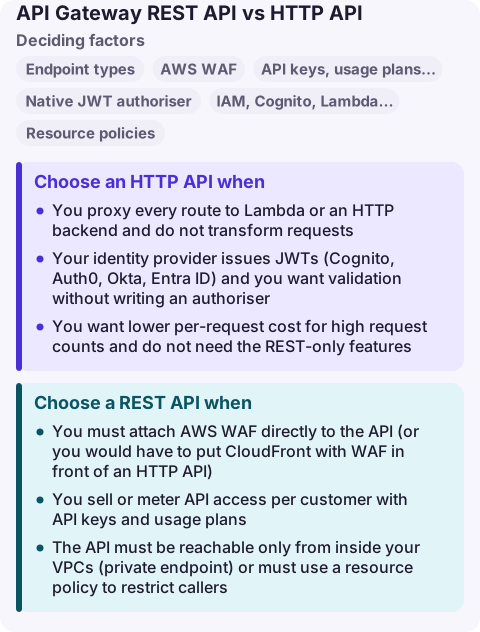
Choose an HTTP API when
- You proxy every route to Lambda or an HTTP backend and do not transform requests.
- Your identity provider issues JWTs (Cognito, Auth0, Okta, Entra ID) and you want validation without writing an authoriser.
- You want lower per-request cost for high request counts and do not need the REST-only features.
- You need private integrations through AWS Cloud Map, which only HTTP APIs support.
Choose a REST API when
- You must attach AWS WAF directly to the API (or you would have to put CloudFront with WAF in front of an HTTP API).
- You sell or meter API access per customer with API keys and usage plans.
- The API must be reachable only from inside your VPCs (private endpoint) or must use a resource policy to restrict callers.
- You rely on request validation, mapping templates, response caching or response streaming.
- You need execution logging and X-Ray traces to debug integration failures.
Migrating between them
There is no in-place conversion. Create the new API, export the old definition as OpenAPI where possible, import it, and recreate authorisers, stages and custom domain mappings. Payload formats differ for Lambda proxy integrations: HTTP APIs default to payload format version 2.0, which changes the event shape, so check your handler before switching.
Cut over with the custom domain: map the new API to the same domain name, test with a separate base path, then move the default mapping.
Common wrong reasons
- "HTTP API is the new version of REST API." They are separate products. REST APIs are not deprecated and have more features.
- "We need REST API because our API is RESTful." Both are RESTful; the name refers to the product, not the style.
- "HTTP API cannot use Cognito." It can, through a JWT authoriser that validates Cognito tokens.
Questions
Is HTTP API cheaper than REST API?
Yes. AWS positions HTTP APIs as having minimal features so they can be offered at a lower price per million requests; see the API Gateway pricing page for current rates.
Does HTTP API support AWS WAF?
No. WAF integrates with REST APIs. For an HTTP API, put CloudFront with WAF in front.
Can HTTP APIs be private?
No. HTTP APIs offer only Regional endpoints. Use a REST API with a private endpoint for VPC-only access.
Without execution logs, an HTTP API failure is diagnosed from access logs and the backend's own logs; with a REST API you have one more trail. CloudConsole is being built to show API alarms and log queries on a phone with production guardrails.
About the app → · Download on the App Store