 CloudConsole
CloudFront vs Global Accelerator
Use CloudFront for websites, APIs and media over HTTP(S): it caches at the edge, speeds up dynamic requests, adds WAF and edge functions, and is usually cheaper per GB. Use Global Accelerator for non-HTTP traffic (TCP or UDP, such as gaming, IoT or VoIP), or for HTTP applications that need fixed static IP addresses and fast, deterministic failover between Regions.
CloudFront vs Global Accelerator compared
| Factor | CloudFront | Global Accelerator |
|---|---|---|
| What it is | Content delivery network (reverse proxy with cache) | Anycast network entry point that proxies packets to Regional endpoints |
| Protocols | HTTP and HTTPS (including WebSockets) | TCP and UDP |
| Caching | Yes, plus origin shield and compression | No |
| Entry point | DNS name; optional Anycast static IP lists (21 addresses, or 3 for apex domains) on request | Two static anycast IPv4 addresses (four with dual-stack), or your own BYOIP |
| Origins / endpoints | S3, ALB, EC2, any HTTP server, Lambda function URLs | ALB, NLB, EC2 instances, Elastic IPs in AWS Regions |
| Failover | Origin groups on HTTP errors | Health-checked endpoint groups across Regions, no DNS caching delay |
| Edge logic | CloudFront Functions, Lambda@Edge, WAF | None (Shield integration only) |
| Pricing model | Pay as you go per GB and request, or flat-rate monthly plans | Hourly fixed fee per accelerator plus a per-GB DT-Premium in the dominant direction |
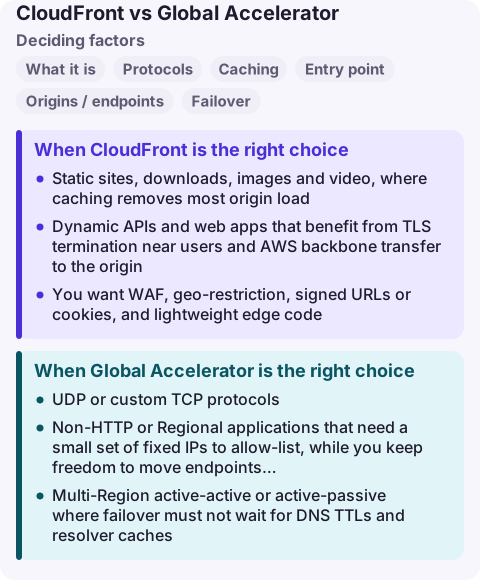
When CloudFront is the right choice
- Static sites, downloads, images and video, where caching removes most origin load.
- Dynamic APIs and web apps that benefit from TLS termination near users and AWS backbone transfer to the origin.
- You want WAF, geo-restriction, signed URLs or cookies, and lightweight edge code.
- Cost-sensitive HTTP delivery at volume.
When Global Accelerator is the right choice
- UDP or custom TCP protocols: game servers, MQTT, SIP and VoIP.
- Non-HTTP or Regional applications that need a small set of fixed IPs to allow-list, while you keep freedom to move endpoints between Regions.
- Multi-Region active-active or active-passive where failover must not wait for DNS TTLs and resolver caches.
- Custom routing accelerators that map users to specific instances and ports, such as game sessions.
Using both
They can be combined, but rarely need to be on the same path. A typical estate puts CloudFront in front of the web and API tier and Global Accelerator in front of a real-time TCP or UDP service. If the reason for Global Accelerator is only static IPs for an HTTP app, compare an NLB with Elastic IPs in front of an ALB inside one Region before paying for global acceleration.
Common wrong reasons
- "Global Accelerator is a faster CDN." It does not cache; for cacheable content CloudFront serves from the edge without touching your origin.
- "CloudFront only helps static content." It also accelerates uncached dynamic requests through persistent connections to the origin.
- "We need Global Accelerator for DDoS protection." Both integrate with AWS Shield; choose on protocol and IP needs instead.
Questions
What is the difference between CloudFront and Global Accelerator?
CloudFront is an HTTP CDN that caches and runs edge logic. Global Accelerator gives you static anycast IPs that carry TCP or UDP traffic over the AWS network to Regional endpoints, without caching.
Does Global Accelerator cache content?
No. It proxies connections to your endpoints. Use CloudFront if you need caching.
Can CloudFront give me a static IP address?
Yes, on request: CloudFront Anycast static IP lists give 21 dedicated addresses for allow-listing, or 3 for routing an apex domain, and require the all-edge-locations price class. Global Accelerator gives two static IPs by default for any TCP or UDP app.
Edge problems are confusing on call because users in one geography fail while your dashboards in another look fine. CloudConsole is being built to show CloudFront and origin alarms on a phone with production guardrails.
About the app → · Download on the App Store