 CloudConsole
Route 53 routing policies compared
Use simple routing for a single endpoint, weighted for gradual traffic shifts and blue/green, latency for active-active multi-Region, and failover for active-passive disaster recovery. Use geolocation when content or compliance depends on the user's country, IP-based when you know your users' network ranges, and multivalue answer for simple client-side spreading across up to eight healthy records.
The eight routing policies
| Policy | Routes by | Typical use |
|---|---|---|
| Simple | One record, no logic | A single load balancer or CloudFront distribution |
| Weighted | Proportions you set | Canary and blue/green deploys, migrations between stacks |
| Latency | Lowest measured latency from the user's network to each Region | Active-active across Regions |
| Failover | Primary while healthy, secondary otherwise | Active-passive disaster recovery |
| Geolocation | User's continent, country or US state | Localised content, licensing, data residency |
| Geoproximity | Distance to your resources, adjustable with a bias | Shifting load between Regions by geography |
| IP-based | CIDR blocks you upload | Routing known ISPs or corporate networks to specific endpoints |
| Multivalue answer | Up to eight healthy records chosen at random | Basic spreading across instances without a load balancer |
Every policy except IP-based can also be used in private hosted zones.
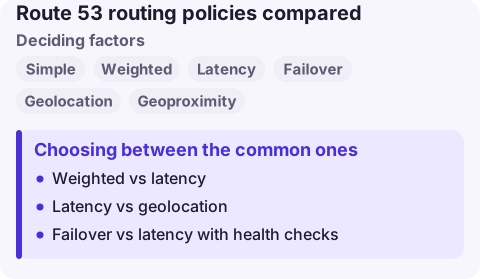
Choosing between the common ones
- Weighted vs latency. Weighted is about how much traffic goes where; latency is about sending each user to the fastest Region. For a new Region, start weighted at a small share, then switch to latency once it is proven.
- Latency vs geolocation. Latency optimises speed and ignores borders. Geolocation obeys borders even if another Region is faster, and needs a default record for locations you do not map.
- Failover vs latency with health checks. Failover keeps a cold or warm standby idle. Latency with health checks runs both sides live and drops an unhealthy Region automatically.
- Multivalue vs a load balancer. Multivalue is not load balancing: clients pick from the answers and cache them. Use it only where clients retry other addresses.
Health checks make or break it
Weighted, latency, failover, geolocation and multivalue records only route away from a broken endpoint if a health check (or alias target health evaluation) tells Route 53 it is unhealthy. For alias records pointing at load balancers, enable "Evaluate target health". For anything else, attach a Route 53 health check or a CloudWatch-alarm-based check.
DNS failover is bounded by TTLs and resolvers that cache longer than they should. Keep TTLs short (for example 60 seconds) on records you expect to fail over, and do not expect instant cut-over.
Combining policies
Policies nest through alias records. A common pattern is latency-based records per Region, each pointing to a weighted set inside that Region, each weighted record pointing to a load balancer with target health evaluation. Another is failover at the top with latency underneath for the primary side. Keep nesting shallow; every level is another place to misconfigure.
Common wrong reasons
- "Geolocation is faster." It ignores network conditions. Use latency routing for speed.
- "Weighted 0 disables a record." It does stop traffic to it if others have weight, but if every record has weight 0 Route 53 returns them all equally.
- "Failover will catch outages without health checks." It cannot know the primary is down unless something tells it.
Questions
What is the difference between latency and geolocation routing?
Latency routing sends users to the Region with the lowest measured latency. Geolocation routing sends them based on where they are, regardless of speed, and needs a default record.
Which Route 53 routing policy should I use for disaster recovery?
Failover routing for active-passive, or latency routing with health checks for active-active. Both depend on health checks to detect the failure.
Can I use weighted routing for blue/green deployments?
Yes. Point two weighted records at the blue and green stacks and move weight gradually, with a short TTL so changes take effect quickly.
During a regional incident you may need to shift weights or confirm a health check flipped, often from wherever you are. CloudConsole is being built to show health-check alarms and resources on a phone with production guardrails.
About the app → · Download on the App Store