 CloudConsole
ElastiCache: Valkey vs Redis OSS vs Memcached
For new ElastiCache clusters, choose Valkey: it is a drop-in replacement for Redis OSS 7 with the same data structures, AWS prices its nodes lower, and new features land there first. Keep Redis OSS only until you can test an upgrade (it is an in-place engine change with the same endpoint). Choose Memcached only for a simple, multi-threaded object cache that needs no replication, persistence or rich data types.
The three engines compared
| Factor | Valkey / Redis OSS | Memcached |
|---|---|---|
| Data types | Strings, hashes, lists, sets, sorted sets, streams, geospatial, more | Simple key-value strings |
| Replication and failover | Replicas, Multi-AZ automatic failover | None; nodes are independent |
| Partitioning | Cluster mode enabled: shards with online resharding | Client-side across nodes |
| Persistence and backup | Snapshots; Valkey 9.0 adds durability via a Multi-AZ transactional log | No |
| Pub/sub, Lua or Functions, transactions | Yes | No |
| Threads | Async I/O threading (Valkey 8.0+) | Multi-threaded |
| Serverless option | Yes (Valkey and Redis OSS) | Yes |
Valkey and Redis OSS share the left column. The differences between them on ElastiCache are price, version roadmap and support: Valkey has newer releases (vector search, full-text search, Bloom filters, hash field expiration), while older Redis OSS major versions move into paid Extended Support after their end of standard support date.
Valkey vs Redis OSS
From the AWS Price List API for us-east-1 at the time of writing, an on-demand cache.r7g.large node costs $0.1752 per hour with Valkey and $0.219 per hour with Redis OSS (and with Memcached), about 20% less for Valkey. ElastiCache Serverless also bills Valkey differently, with a lower minimum data storage per cache (100 MB versus 1 GB for Redis OSS and Memcached).
Upgrading from Redis OSS to Valkey is a modify operation that keeps the endpoint DNS name; node IP addresses change for node-based clusters. AWS notes that upgrades from Redis OSS versions earlier than 5.0.6 may see a 30 to 60 second failover during DNS propagation. Engine changes cannot be downgraded, so test on a copy restored from a snapshot first.
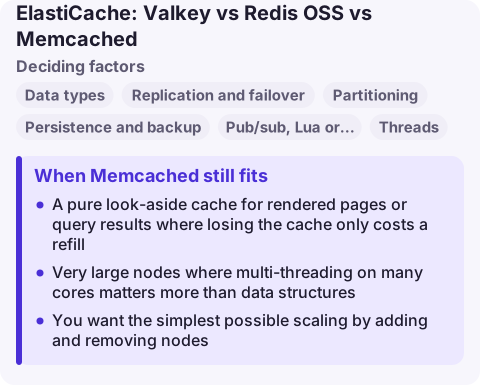
When Memcached still fits
- A pure look-aside cache for rendered pages or query results where losing the cache only costs a refill.
- Very large nodes where multi-threading on many cores matters more than data structures.
- You want the simplest possible scaling by adding and removing nodes.
If you need any of high availability, persistence, sorted sets, pub/sub or atomic counters across failover, Memcached is the wrong engine.
Choosing node-based or serverless
Node-based clusters suit steady load where you can size memory and keep Reserved Nodes or Database Savings Plans covering them. ElastiCache Serverless suits spiky or unknown load: it bills data stored in GB-hours and requests in ElastiCache Processing Units, and scales without choosing node types.
Common wrong reasons
- "Valkey is a risky fork." It is an open-source continuation of Redis OSS 7.2 under the Linux Foundation, and AWS supports it as a first-class ElastiCache engine.
- "Memcached is faster because it is simpler." For typical cache workloads both are sub-millisecond; choose on features and availability.
- "We can stay on Redis OSS 4 or 5." You can, but Extended Support charges apply after standard support ends.
Questions
Is Valkey compatible with Redis?
Valkey is designed as a drop-in replacement for Redis OSS 7. Existing Redis clients and commands work, and ElastiCache supports upgrading a Redis OSS cluster to Valkey in place.
Is ElastiCache for Valkey cheaper than Redis OSS?
Yes for node-based clusters: at the time of writing, Valkey node-hours in us-east-1 are about 20% lower than Redis OSS for the same node type, according to the AWS Price List API.
When should I use Memcached instead of Redis or Valkey?
Only for a simple, disposable object cache that benefits from multi-threaded nodes and needs no replication, persistence or complex data types.
A cache that fills up or fails over causes a sudden load spike on the database behind it, so the page you get may be from the database, not the cache. CloudConsole is being built to show both sets of alarms on a phone with production guardrails.
About the app → · Download on the App Store