 CloudConsole
Savings Plans vs Reserved Instances
For EC2, Fargate and Lambda, buy Savings Plans: AWS itself recommends them over Reserved Instances, and Compute Savings Plans follow your usage across instance families, Regions and services. Reserved Instances still matter where Savings Plans do not reach (for example RDS, ElastiCache and other database instances unless a Database Savings Plan fits better) and when you need a zonal RI to reserve capacity.
Savings Plans vs RIs compared
| Factor | Savings Plans | Reserved Instances |
|---|---|---|
| Commitment | $ per hour of usage for 1 or 3 years | A specific instance configuration for 1 or 3 years |
| Maximum discount (EC2) | Compute: up to 66%; EC2 Instance: up to 72% | Convertible: up to 66%; Standard: up to 72% |
| Flexibility | Compute: any family, size, OS, tenancy, Region, plus Fargate and Lambda | Standard: fixed family; Convertible: exchangeable manually |
| Capacity reservation | None (pair with On-Demand Capacity Reservations) | Zonal RIs reserve capacity in one AZ |
| Resale | Cannot be sold or cancelled | Standard RIs can be sold on the RI Marketplace |
| Other services | Database and SageMaker AI Savings Plans exist | RDS, ElastiCache, OpenSearch, Redshift and others have their own RIs |
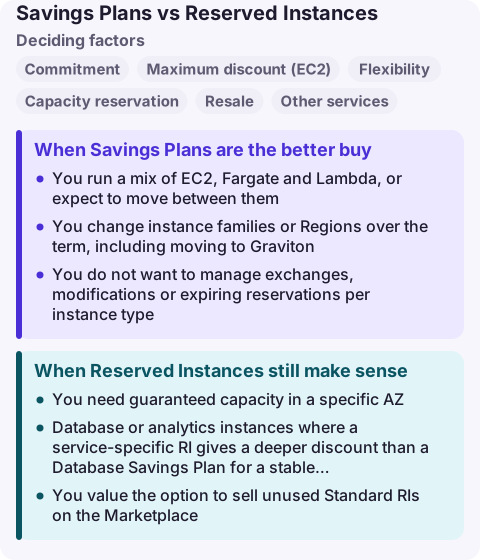
When Savings Plans are the better buy
- You run a mix of EC2, Fargate and Lambda, or expect to move between them. One Compute Savings Plan covers all three.
- You change instance families or Regions over the term, including moving to Graviton.
- You do not want to manage exchanges, modifications or expiring reservations per instance type.
- Databases across engines: Database Savings Plans cover Aurora, RDS, DynamoDB, ElastiCache and others (up to 35%), including serverless usage, regardless of engine or Region.
Pick EC2 Instance Savings Plans only if you are confident a workload stays in one family and Region for the full term; you trade flexibility for the extra discount.
When Reserved Instances still make sense
- You need guaranteed capacity in a specific AZ: zonal RIs reserve it; Savings Plans never do.
- Database or analytics instances where a service-specific RI gives a deeper discount than a Database Savings Plan for a stable instance class. Compare both in Cost Explorer.
- You value the option to sell unused Standard RIs on the Marketplace.
Buying without regret
- Start from Cost Explorer's Savings Plans recommendations, based on your last 7, 30 or 60 days.
- Commit to your steady floor, not your average. Usage above the commitment is billed On-Demand; unused commitment is still charged.
- Remember the order: RIs apply first, then Savings Plans. Spot usage is never covered.
- Stagger purchases (for example quarterly) so expiries and changes in usage do not land at once.
- Watch utilisation and coverage reports monthly and set a budget alert on Savings Plans utilisation.
Common wrong reasons
- "RIs are cheaper." Headline maxima match: Compute SP equals Convertible RI, EC2 Instance SP equals Standard RI.
- "Savings Plans reserve capacity." They do not. Use On-Demand Capacity Reservations if you need it.
- "Buy three years all upfront for the biggest discount." Only if the workload will clearly exist in that form; a commitment cannot be cancelled.
Questions
Do Savings Plans apply to RDS?
Compute and EC2 Instance Savings Plans do not. Database Savings Plans cover RDS, Aurora, DynamoDB, ElastiCache and other database services; RDS Reserved Instances remain an alternative.
Can I cancel a Savings Plan?
No. Commitments cannot be cancelled or changed after purchase. You can buy additional plans as usage grows.
Do Savings Plans cover the EKS cluster fee?
No. They apply to the EC2 instances in EKS, ECS and EMR clusters, and Compute plans cover Fargate, but the EKS cluster charge itself is not covered.
Commitment mistakes surface as a cost anomaly weeks later, not as an outage. CloudConsole is being built to show costs and alarms on a phone with production guardrails, so a spend spike is visible the day it starts.
About the app → · Download on the App Store