 CloudConsole
Secrets Manager vs Parameter Store
Use Secrets Manager for credentials that should rotate (database passwords, API keys you can rotate), need cross-Region replication or must be shared across accounts with resource policies; you pay per secret per month plus API calls. Use Parameter Store for configuration and for secrets that do not rotate automatically: SecureString parameters are KMS-encrypted and standard parameters cost nothing.
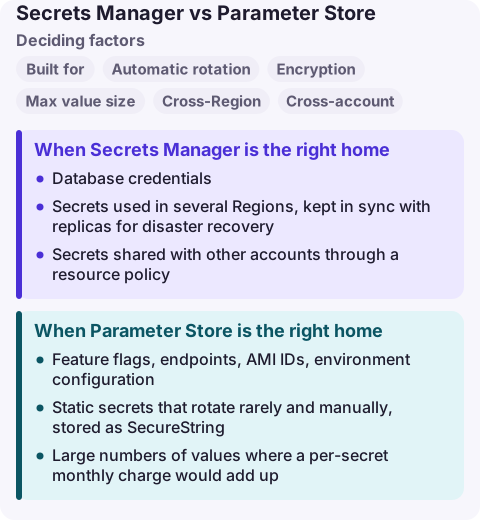
Secrets Manager vs Parameter Store compared
| Factor | Secrets Manager | Parameter Store |
|---|---|---|
| Built for | Secrets with a lifecycle | Configuration values and simple secrets |
| Automatic rotation | Yes, managed rotation for RDS and others, or a Lambda function | No (parameter policies can expire or notify on advanced parameters) |
| Encryption | Always, with KMS | SecureString with KMS; String and StringList unencrypted |
| Max value size | 65,536 bytes | 4 KB standard, 8 KB advanced |
| Cross-Region | Replica secrets | No built-in replication |
| Cross-account | Resource-based policy on the secret | Advanced parameters can be shared |
| Versioning | Staging labels (AWSCURRENT, AWSPREVIOUS) | Parameter history and labels |
| Pricing model | Per secret per month plus per 10,000 API calls | Standard: no charge; advanced: per parameter per month; higher throughput charged per API interaction |
When Secrets Manager is the right home
- Database credentials: managed rotation for RDS and Aurora, including alternating-users rotation so connections keep working.
- Secrets used in several Regions, kept in sync with replicas for disaster recovery.
- Secrets shared with other accounts through a resource policy.
- You need an audit trail of rotation and a clear current/previous version for safe roll-forward.
When Parameter Store is the right home
- Feature flags, endpoints, AMI IDs, environment configuration: plain String parameters organised by path.
- Static secrets that rotate rarely and manually, stored as SecureString.
- Large numbers of values where a per-secret monthly charge would add up.
Mind throughput: by default GetParameter, GetParameters and GetParametersByPath share 40 TPS per account and Region. Enabling higher throughput lifts that substantially but adds a charge per API interaction. Cache values in your application or use the Parameters and Secrets Lambda extension.
Using both
Parameter Store can reference Secrets Manager secrets through the /aws/reference/secretsmanager/ path, so applications that already read parameters can fetch a rotated secret without a second client. CloudFormation dynamic references ({{resolve:secretsmanager:...}} and {{resolve:ssm-secure:...}}) and ECS task definition secrets support both services.
Common wrong reasons
- "Parameter Store is not secure enough for secrets." SecureString uses KMS just like Secrets Manager; the difference is rotation and lifecycle features.
- "Secrets Manager for everything is simpler." It is, until you have thousands of configuration values each with a monthly charge.
- "Rotation is automatic once enabled." Your applications must re-read the secret (or cache with a short TTL) to pick up new values.
Questions
Is Parameter Store free?
Standard parameters with standard throughput have no additional charge. Advanced parameters and higher throughput are charged.
Can Parameter Store rotate secrets?
No. Use Secrets Manager for automatic rotation, or rotate SecureString values yourself with your own automation.
What is the maximum secret size?
Secrets Manager secret values can be up to 65,536 bytes. Parameter Store values are limited to 4 KB (standard) or 8 KB (advanced).
A rotation that fails, or an app that never picked up the new password, shows up as sudden authentication errors from a database. CloudConsole is being built to show those alarms and logs on a phone with production guardrails.
About the app → · Download on the App Store